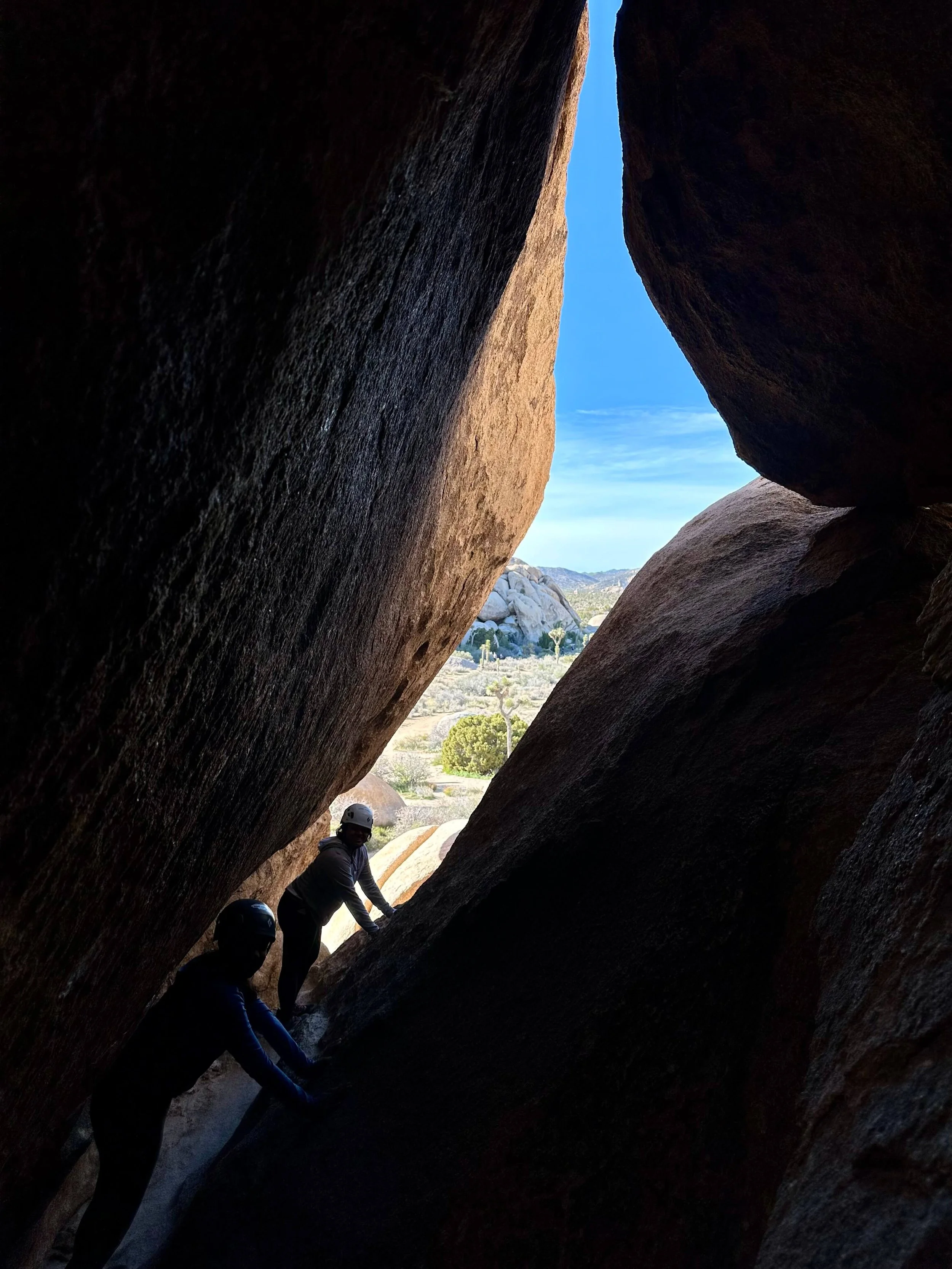
Skull Rock Trail Guide: Joshua Tree's Most Iconic Hike
There are plenty of hikes in Joshua Tree National Park, but one rock stops everyone in their tracks: Skull Rock. Sitting just 70 feet from the parking area along Park Boulevard, this massive monzogranite boulder has been shaped by millennia of wind and water into a formation that unmistakably resembles a human skull — complete with hollowed eye sockets staring out over the Mojave.
The 1.7-mile Skull Rock Nature Trail loops you through the heart of the Jumbo Rocks area, winding past towering boulder piles, sandy washes, and a stretch of Jumbo Rocks Campground before crossing Park Boulevard and returning through open desert. It's accessible enough for first-timers and kids, yet fascinating enough for anyone curious about how Joshua Tree's extraordinary landscape was built.
This guide covers everything you need: what you'll see, how the trail flows, when to go, where to park, what to bring, and how to extend the hike when you want more miles.
.jpg)
There are plenty of hikes in Joshua Tree National Park, but one rock stops everyone in their tracks: Skull Rock. Sitting just 70 feet from the parking area along Park Boulevard, this massive monzogranite boulder has been shaped by millennia of wind and water into a formation that unmistakably resembles a human skull — complete with hollowed eye sockets staring out over the Mojave.
The 1.7-mile Skull Rock Nature Trail loops you through the heart of the Jumbo Rocks area, winding past towering boulder piles, sandy washes, and a stretch of Jumbo Rocks Campground before crossing Park Boulevard and returning through open desert. It's accessible enough for first-timers and kids, yet fascinating enough for anyone curious about how Joshua Tree's extraordinary landscape was built.
This guide covers everything you need: what you'll see, how the trail flows, when to go, where to park, what to bring, and how to extend the hike when you want more miles.
The Skull Rock Formation
Skull Rock is made of monzogranite — the pale, coarse-grained granite that forms nearly all of Joshua Tree's dramatic boulder formations. The rock crystallized from magma deep underground roughly 75 to 250 million years ago. As the overlying material eroded away over tens of millions of years, pressure on the granite relaxed, causing it to expand and crack along horizontal and vertical joint lines.
Groundwater moved through those cracks and rounded the sharp corners of each block through a process called spheroidal weathering — attacking edges and corners faster than flat faces, slowly transforming angular blocks into rounded boulders. Flash floods eventually excavated the surrounding sediment, exposing those pre-rounded boulders and stacking them into the piles visible today.
The skull-like pockets are the result of a separate, slower process called tafoni. Moisture and salt seep into microscopic pores in the rock surface, then crystallize and expand, popping off tiny flakes over thousands of years. Softer patches in the granite erode faster than harder ones, hollowing out the cavities that resemble eye and nose sockets. No one carved them — they're a textbook example of desert rock weathering, readable in seconds from the parking lot.
.jpg)
Walking the Trail, Step by Step
The loop can be hiked in either direction. Starting clockwise from the Skull Rock Parking Area is the most common approach and is described below. The trail is signed, mostly sandy or hard-pack dirt, and straightforward to follow throughout.
- Skull Rock Parking Area — Begin at the dedicated pullout on the south side of Park Boulevard. From the trailhead, Skull Rock is already visible — it's just ~70 feet away.
- Skull Rock — Get up close. The eye sockets and nose cavity are easy to identify. Look for additional tafoni pockets scattered across the surrounding boulders while you're here.
- Southwest through the boulder field — Pass the right side of Skull Rock and turn right, winding deeper into the granite landscape. Terrain alternates between soft sand and bare rock surface.
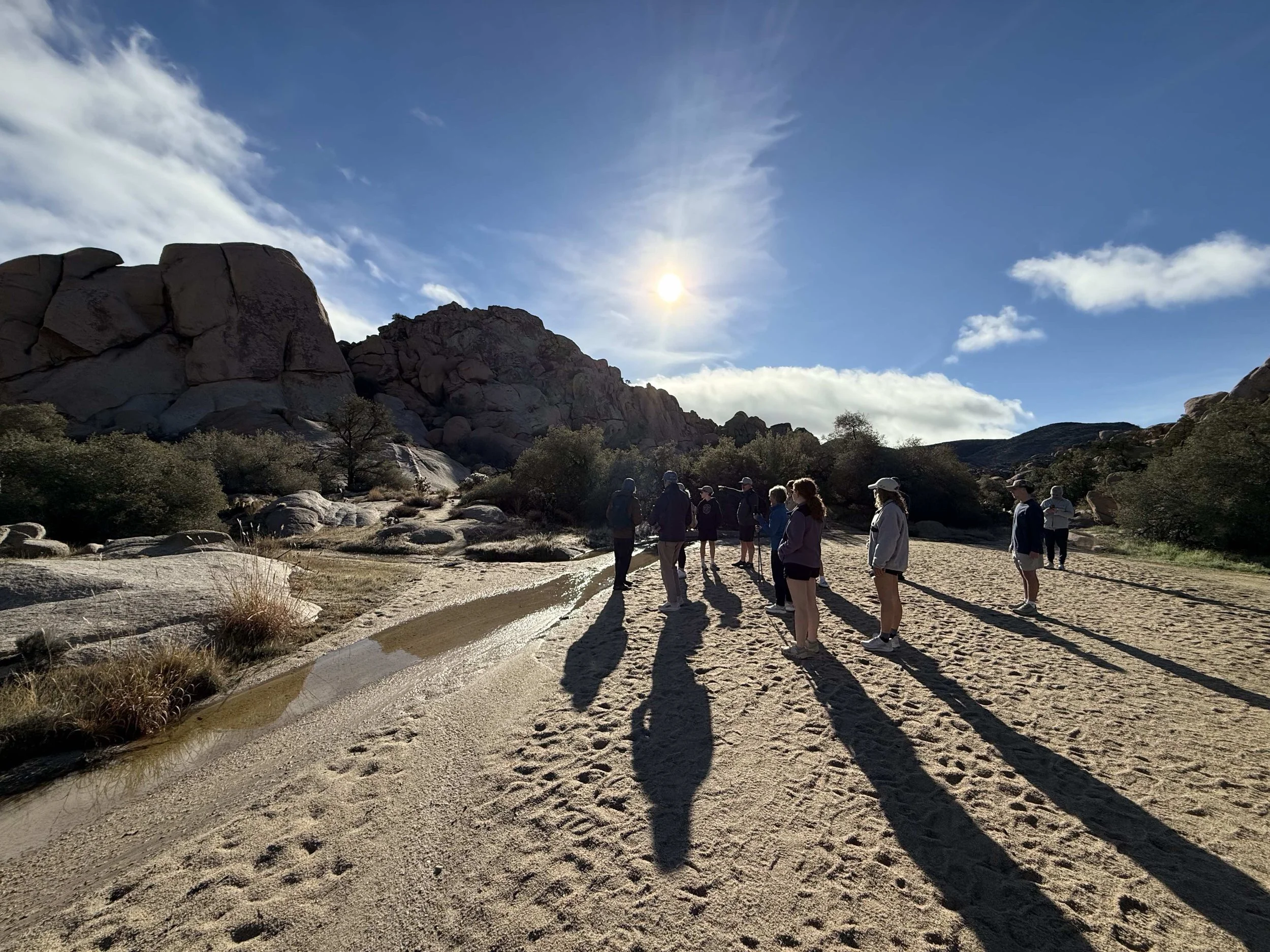
- Desert washes — The trail dips in and out of sandy washes — flat-bottomed channels carved by flash floods. Watch for Joshua trees, cholla, creosote, Mojave yucca, pinyon, and juniper along the route.
- Jumbo Rocks Campground — The trail merges with a campground road. Turn right and walk toward the campground entrance. Pit toilets are available here (no running water).
- Cross Park Boulevard — At the campground entrance, the trail crosses the road. Look both ways — this is an active two-lane highway.
- North side return — On the north side of the road, the trail meanders through open desert. Discovery Trail access is here for anyone extending the hike. To complete the loop, turn east (left) toward the parking area.
- Back to the parking area — The trail curves east through boulder terrain and sandy flats, returning you to the Skull Rock Parking Area to close the loop.
What to Look For Along the Way
Beyond Skull Rock itself, the trail is a geology classroom. Here's what to watch for as you complete the loop.
Tafoni Pockets
Skull Rock is the most dramatic example, but tafoni appear on boulders throughout the trail — some shallow divots, others deep enough to shelter a coyote. They're most pronounced on north-facing rock surfaces where moisture lingers longer.
Desert Varnish
Many boulders wear a dark, almost glossy coating called desert varnish — a slow accumulation of manganese and iron oxides deposited by microorganisms over thousands of years. The darker the varnish, the longer that rock face has been exposed to the sky.
Desert Washes
The sandy flat-bottomed channels crossing the trail are dry washes — drainage routes shaped by flash floods. These floods are responsible for excavating the boulders from the surrounding soil and are why the rock piles look so dramatically stacked.
Plant Diversity
Skull Rock sits near the ecological boundary between the Mojave and Colorado Deserts. You'll find Mojave species — Joshua trees, Mojave yucca, pinyon pine, juniper — mixing with lower-desert plants like creosote, ocotillo, paperbag bush, and various chollas all within the same short loop.
.jpg)
Extending the Hike: Discovery Trail & Split Rock Loop
If 1.7 miles isn't enough, the Skull Rock loop connects directly to a much bigger day. The Discovery Trail branches off the north side after you cross Park Boulevard and links to the Split Rock Loop, bringing your total to approximately 5 to 6 miles through some of the park's most dramatic boulder terrain.
Getting There & Parking
The Skull Rock Parking Area is a well-signed dedicated pullout on Park Boulevard — there's no confusion about where to go. You can access the trail from two points:
Skull Rock Parking Area (Recommended for Day Hikers)
The main lot accommodates cars, vans, and RVs. From Oasis Visitor Center in Twentynine Palms, drive west on Park Boulevard for 11 miles. From Joshua Tree Visitor Center, drive east on Park Boulevard for 23 miles. The parking area is on the south side of the road.
Jumbo Rocks Campground
Campers at Jumbo Rocks Campground access the trail from inside the campground, near the amphitheater. Day-use parking in the campground is extremely limited — hikers who park in campsites without a reservation are subject to a fine. Use the main lot instead.
Parking Tips
The lot fills fast on weekends, holidays, and throughout spring (February–April). Arriving before 8 am or after 3 pm gives you the best odds. No trail reservation is needed — just a valid park entrance pass (or America the Beautiful annual pass).
Best Time to Visit
The Skull Rock Trail has almost no shade. That single fact dictates when you should go.
What to Bring
No cell service, no water sources, almost no shade. Even for a short 1.7-mile loop, pack the essentials.
- Water — at least 1 liter per person
- Sun hat and sunscreen
- Sunglasses
- Sturdy closed-toe shoes
- Snacks (if adding Discovery Trail)
- Park entrance pass or annual pass
- Downloaded offline trail map
- Light layers for winter mornings
More Ways to Explore


Ready to Go Beyond the Trail?
Summit Climbing Guides leads rock climbing and adventure route experiences through the very same boulder fields surrounding Skull Rock. No experience needed — just a willingness to get off the trail and onto the rock.
Frequently Asked Questions