
Rock Climbing Gear List
For the folks just getting into the vertical world!
Rock Climbing Gear List
For the folks just getting into the vertical world!
New to climbing and wondering what gear you actually need? This list breaks down the essentials — what each piece does, what to look for, and where to find it if you’re ready to start building your own kit.
If you’re joining us for a guided trip, good news: you don’t need to buy any of this. On a Summit Climbing Guides trip, we provide every item below — harnesses, helmets, shoes, ropes, and more — cleaned and safety-checked before each climb. This list is here so you know your kit inside and out. Building your own gear bag down the road? This is a great place to start.
Pack Your Bag
Tap each item as you check it off your kit. Get all 8 and you’re ready to climb.
You’re Ready to Climb!
Bag’s packed and you’ve got the basics down. Let’s get you on the rock.
Book NowWant to learn about commonly used climbing knots?
We put together a full step-by-step guide to hitches and the other essential climbing knots — with real photos from right here in Joshua Tree.Know Your Gear
Tap any item below for a closer look at how it works — plus links if you’re ready to start building your own kit.
 Climbing Shoes
+
Climbing Shoes
+
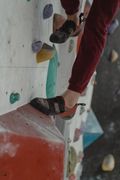
Climbing shoes are basically a delivery system for friction. The shape and sticky rubber sole let you stand on edges the width of a credit card and trust holds that would slip right out from under a sneaker. For most of what we climb in Joshua Tree — vertical face and crack climbing on textured granite — a flat-to-neutral shoe with a fairly stiff sole is the sweet spot.
Two classics worth knowing: the La Sportiva Tarantulace is an affordable, comfortable, beginner-friendly lace-up with a roomy toe box, and the La Sportiva Mythos is a legendary all-day-comfort shoe a lot of trad climbers swear by for long approaches and multi-pitch days.
 Harness
+
Harness
+
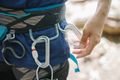
A good harness should disappear once you’re climbing — comfortable on hangs, easy to adjust, built so your gear loops stay put while you’re racking up. The Black Diamond Momentum is REI’s go-to value pick and a great first harness: four buckles mean it adjusts to fit over a t-shirt in summer or a puffy in cooler months, and the padded waistbelt holds up well through a long day at the base of a route.
 Helmet
+
Helmet
+
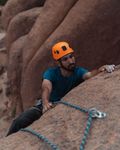
A helmet protects you two ways: from rock or gear falling from above, and from your own head meeting the wall if you fall and swing. Foam-construction helmets absorb that impact and have gotten dramatically lighter and more comfortable in recent years — there’s really no good reason to skip one anymore. Fit matters most: it should sit level and low on your forehead, and stay put when you shake your head “no.”
 Belay Device
+
Belay Device
+
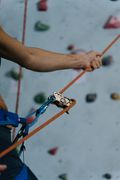
Every belay device does the same basic job — create enough friction on the rope to catch a fall — but there are two very different families worth knowing.
The ATC (manual)
Black Diamond’s ATC family are classic tube-style devices: light, simple, and 100% manual — all the braking comes from your brake hand. That simplicity is exactly why guides love them. They work great for rappelling, multi-pitch, and a wide range of rope diameters, with nothing mechanical to fail. The ATC-Guide adds an auto-blocking mode for bringing up a second climber.
The GriGri (assisted-braking)
Petzl’s GriGri family use a cam inside the device that pinches the rope when it’s loaded, adding a real margin of safety — especially for newer belayers or long days at the crag. The GriGri+ adds an anti-panic handle that’s especially forgiving while you’re still building belay habits.
Most guides end up carrying both — an ATC for trad days and rappelling, a GriGri for sport climbing — and you’ll see us using each depending on the day’s objective.
 Climbing Rope
+
Climbing Rope
+
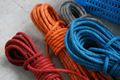
A dynamic rope is built to stretch — that stretch is what absorbs the shock of a fall and keeps the forces on you (and your gear) manageable. Diameter is a trade-off between weight and durability: something in the 9.5–9.8mm range is a great do-it-all choice for sport and trad. Length matters too — 60 meters is the standard, but some of the longer routes and raps in Joshua Tree are more comfortable with a 70m.
 Anchor Rope
+
Anchor Rope
+
This is the rope’s quieter cousin: the cord used to build anchors. Where a climbing rope is designed to stretch, anchor material is the opposite — you want it static, with as little stretch as possible, so the anchor stays put under load. A classic setup is a cordelette: an 18–20 ft. loop of 7–8mm accessory cord tied to connect multiple anchor points into one strong point. It’s not the rope you climb on, but it’s just as important to the system.
 Carabiners
+
Carabiners
+
Not all carabiners do the same job. Locking carabiners — with a sleeve or twist-lock gate — go anywhere a mistake would be dangerous: clipped into your belay device, your anchor, or your rappel setup. Non-locking carabiners, often with a bent gate for faster clipping, are what you’ll find racked on quickdraws and slings. A solid kit has a healthy mix of both.
 Friction Hitches
+
Friction Hitches
+
A friction hitch is a loop of cord wrapped around the main rope that grips tight under load but slides freely by hand when it’s unweighted — which makes it the standard backup for rappelling, and a handy tool for ascending a fixed line.
We like the Sterling HollowBlock2. It’s a hollow-braid sling that ties off as either a prusik or a Klemheist, so there are no extra knots to fuss with on the rock. On rappel, we typically tie it as a Klemheist or an autoblock below the belay device — the Klemheist holds a touch better and works fine even with a webbing sling, while the autoblock is just slightly quicker to set and release. Both are solid; which one we reach for is mostly habit.
Quickdraws vs. Cams
Two of the most important pieces of protection in climbing — and they couldn’t work more differently.
Sport Climbing
Quickdraws
On a sport route, the protection — bolts — is already drilled into the rock. A quickdraw is simply two carabiners (one straight-gate for the bolt, one bent-gate for the rope) joined by a short sewn sling, so all you have to do is clip in as you climb. Most routes need a dozen or fewer draws; longer or wandering routes might call for 16 or more, plus a few extra-long slings to keep the rope running straight.
Trad Climbing
Cams
On a trad route, there are no bolts — you bring your own protection and place it in cracks as you climb. Spring-loaded camming devices (cams) have 3–4 lobes on a common axle: squeeze the trigger, slot it into a crack, and release. The lobes expand against the rock, and a fall only pulls them tighter. Building a trad rack means carrying a wider range of gear, since you’re creating your own protection instead of clipping what’s already there.
Skip the gear — we bring everything.
On a guided Summit trip, every item on this list is provided, cleaned, and safety-checked. Your only job is to show up and climb.
Book a Guided Adventure