Wall Street Mill Trail Guide: History, Gold Mining & Desert Intrigue in Joshua Tree
Most people come to Joshua Tree for the boulders and the sky. Wall Street Mill Trail delivers that — and then layers on a century of desert drama that you won't find anywhere else in the park. A 1.4-mile out-and-back from the Barker Dam Road lot, the trail leads to the best-preserved gold ore stamp mill in the entire Mojave Desert, a rusted vintage car half-swallowed by the landscape, and a stone marker commemorating one of the most extraordinary true-crime stories in national park history.
.jpg)
The Park's Most Historically Charged Easy Hike
Most people come to Joshua Tree for the boulders and the sky. Wall Street Mill Trail delivers that — and then layers on a century of desert drama that you won't find anywhere else in the park. A 1.4-mile out-and-back from the Barker Dam Road lot, the trail leads to the best-preserved gold ore stamp mill in the entire Mojave Desert, a rusted vintage car half-swallowed by the landscape, and a stone marker commemorating one of the most extraordinary true-crime stories in national park history.
The mill is listed on the National Register of Historic Places and its original machinery is still largely intact — a rare thing. This isn't a ruin in name only. You can see the two-stamp crusher, the ore tramway, the slurry tables, and the gasoline engine that once powered the whole operation. If you combine it with the nearby Barker Dam Trail, you have one of the richest half-day itineraries in Joshua Tree.
Bill Keys and the Wall Street Gold Mill

Wall Street Mill was designed and built in 1933 by Bill Keys, one of the most remarkable figures in Joshua Tree's history. Keys was a rancher, miner, and self-sufficient homesteader who lived at the Desert Queen Ranch — just a few miles away — for decades. He built the mill using late 19th-century two-stamp Baker Iron Works machinery that he moved from Pinon Wells, powering it with a gasoline engine built by the Western Gas Engine Company of Los Angeles.
The mill processed gold ore using a gravity-fed system: ore was hauled up a wooden tramway ramp at the top, crushed by the two stamps, then processed over a Myer concentrating table to separate the gold. A well on site supplied the water the milling process required. The complex originally included the mill building, the well, a bunkhouse, and an outhouse — the supporting structures are largely ruinous today, but the mill itself remains remarkably intact.
It is the only gold ore crushing mill in the region that retains this level of integrity, which is why it earned a spot on the National Register of Historic Places in 1975. Read more about Bill Keys and the full human history of Joshua Tree in our history guide.

Trail Walk-Through: Step by Step
The Wall Street Mill Trail is a straightforward out-and-back with clear signage throughout. Here's what you'll encounter from trailhead to mill:
Park at the Barker Dam Trailhead lot, which has vault toilets and an accessible restroom. The Wall Street Mill Trailhead sign is at the same lot. Follow the signed path heading northwest. The lot fills quickly on weekends and holidays — arrive by 8 a.m. to be safe.
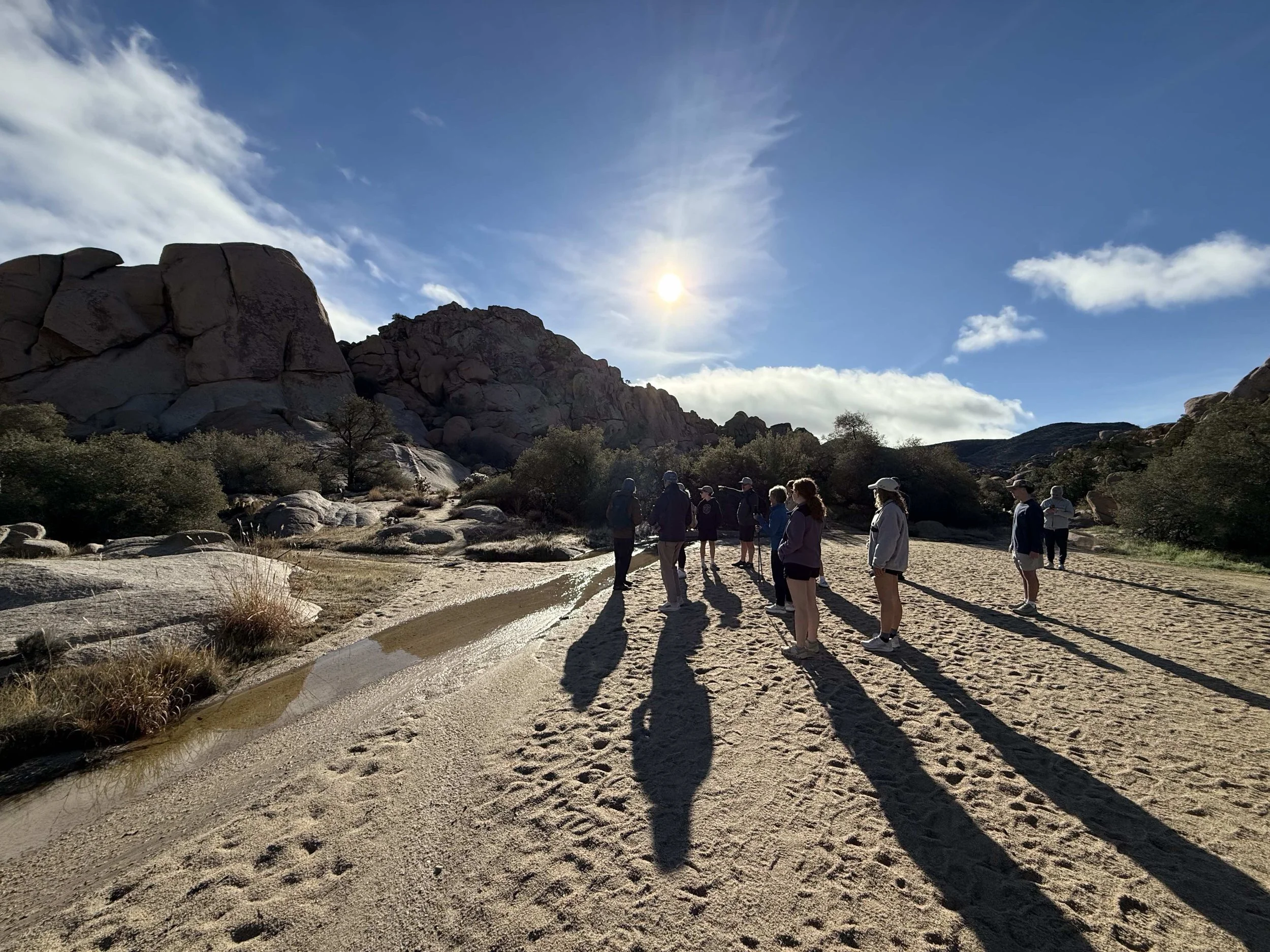
The first stretch crosses open desert flats dotted with Joshua trees and low scrub. About a quarter mile in, you'll pass Cowboy Well — a historic water source tied to the ranching era. Look for birds of prey perching on the ironwork overhead early in the morning.
As you approach the mill, a rusted vintage car appears beside the trail — one of the most-photographed objects in the northern park. It dates to the Keys era and has sat here ever since, slowly being reclaimed by the desert. A perfect photo opportunity against the boulder backdrop.
The mill appears at the end of the trail, nestled against a rocky hillside. Walk around the building to see the ore tramway ramp descending from the upper level, the well, and the ruined outbuildings. The two-stamp crusher and gasoline engine are visible through openings in the corrugated metal walls. Do not climb on or enter the structure.
Just beyond the mill, the reconstructed Worth Bagley Stone marks the spot where Bill Keys shot Worth Bagley in 1943. The original stone Keys carved was replaced by a metal replica after vandalism. The inscription reads: "Here is where Worth Bagley bit the dust at the hand of W. F. Keys, May 11, 1943." Note that this marker is not officially part of the Wall Street Mill historic district.
Retrace your steps back along the same trail. The return walk is equally scenic and often quieter in the late morning as the earlier crowds clear out. Total round-trip time is typically 45 minutes to 1.5 hours depending on how long you linger at the mill.
The Shooting: A Desert Murder, a Pardon, and a Stone
In May 1943, Bill Keys shot and killed Worth Bagley at the entrance to Wall Street Mill. The dispute stemmed from a long-running conflict over access rights to the property. Keys turned himself in and was convicted of manslaughter, sentenced to ten years at San Quentin State Penitentiary.
Upon returning home, Keys did something no one expected: he carved a stone marker and placed it at the site of the shooting, with the now-famous inscription. The original stone was later vandalized (with green paint added to the lettering), and the NPS replaced it with a reconstructed metal version. That replica stands at the site today.

Getting There & Parking
From Park Boulevard, turn left (north) onto Barker Dam Road approximately 9 miles east of the West Entrance Station. Follow it about 1.5 miles to the parking lot. The road is paved and accessible to all standard vehicles. The lot is shared with Barker Dam Trail hikers — on busy spring weekends it fills by mid-morning. Arrive by 8 a.m. to guarantee a spot.
Best Time to Visit
Combine It: Wall Street Mill + Barker Dam
The Barker Dam Trail starts from the same parking lot and is one of the most rewarding pairings in the park. Barker Dam is a 1.3-mile easy loop featuring a century-old cattle dam, 2,000-year-old petroglyphs, and prime bighorn sheep habitat. Hiking both trails in one outing gives you roughly 2.5–3 miles of history-packed desert terrain and covers two National Register of Historic Places sites in a single morning.
What to Bring
- Water — at least 1 liter per person per hour
- Sunscreen and lip balm
- Sturdy closed-toe shoes or hiking boots
- Wide-brimmed hat and sunglasses
- Snacks — trail mix, energy bars, fruit
- Offline maps — no cell service at trailhead
- Camera or charged phone for the mill and car
- Light jacket for early morning or winter hikes
- Binoculars for birds and distant boulder watching
- Trash bag — pack out all waste
More Joshua Tree Guides
.jpg)
Frequently Asked Questions