Rappelling in Joshua Tree National Park: The Complete 2026 Guide

The first time you step backward off a granite ledge in Joshua Tree — ropes tight, desert stretched out for miles below you — something shifts. You expected fear. What you get is focus.
The rock is warm under your hands. The harness holds. And before you know it, you're moving down a face that looked impossible from the ground, grinning in a way you haven't in years. We've guided hundreds of first-time rappellers through exactly that moment. They book because they want something different. They leave because they can't believe they almost didn't do it.
- What Is Rappelling, and Why Does Joshua Tree Make It Special?
- Where Summit Guides Rappelling in Joshua Tree
- What You'll Experience on a Guided Adventure
- Who Is Rappelling Right For?
- Beginner vs. Advanced: Choosing Your Level
- Essential Gear — All Provided
- Safety: What Our Guides Manage
- Best Time of Year for Rappelling in Joshua Tree
- Rappelling vs. Rock Climbing vs. Adventure Routes
- Frequently Asked Questions
- How to Book Your 2026 Adventure
What Is Rappelling, and Why Does Joshua Tree Make It Special?
Rappelling — also called abseiling — is the controlled descent of a vertical surface using a rope, a harness, and a friction device that lets you manage your speed on the way down. In a guided setting, your guide builds the anchor at the top, threads the rope, demonstrates the technique, and stays with you every step of the way.
But the mechanics are only part of what makes rappelling remarkable. The other part is the environment — and Joshua Tree's environment is unlike anywhere else we've ever guided.
Joshua Tree National Park sits at the meeting point of the Mojave and Colorado deserts, at an elevation that keeps temperatures cooler and the air clearer than the valley floors below. The rock is monzogranite: a coarse-grained stone formed from magma that cooled slowly underground over 100 million years ago, then pushed to the surface and sculpted by erosion into the rounded domes, jagged faces, and hidden corridors that make the park look like another planet.
That granite is uniquely suited to rappelling. The texture grips your feet without shredding gear. The faces are clean — long, unbroken descents without the ledges and loose rock that complicate rappelling in other ranges. And our backcountry locations put you in places most park visitors never find: quiet, remote, with 360-degree desert views and no crowds at the base.
This is not gym rappelling. This is not a tourist wall at a resort. This is the real thing.

Where Summit Guides Rappelling in Joshua Tree
We don't guide on the same faces everyone uses. Our rappelling locations are carefully selected backcountry sites — chosen for their quality, their flow, and the experience they create for our guests.
- Towering natural granite faces with long, clean descents that build real confidence
- Hidden backcountry terrain accessed by short off-trail scrambles — the approach is part of the adventure
- Scenic cliff edges with open desert views stretching to the horizon during descent
- Remote locations far from the crowded areas most visitors see
We've scouted these sites over years of guiding, and we rotate based on conditions, group size, and experience level. When you book with Summit, you're not going to a standardized route — you're going to the right route for your group. We don't publish the specific locations. That's intentional. Part of what makes these spots special is that they feel discovered, not processed.
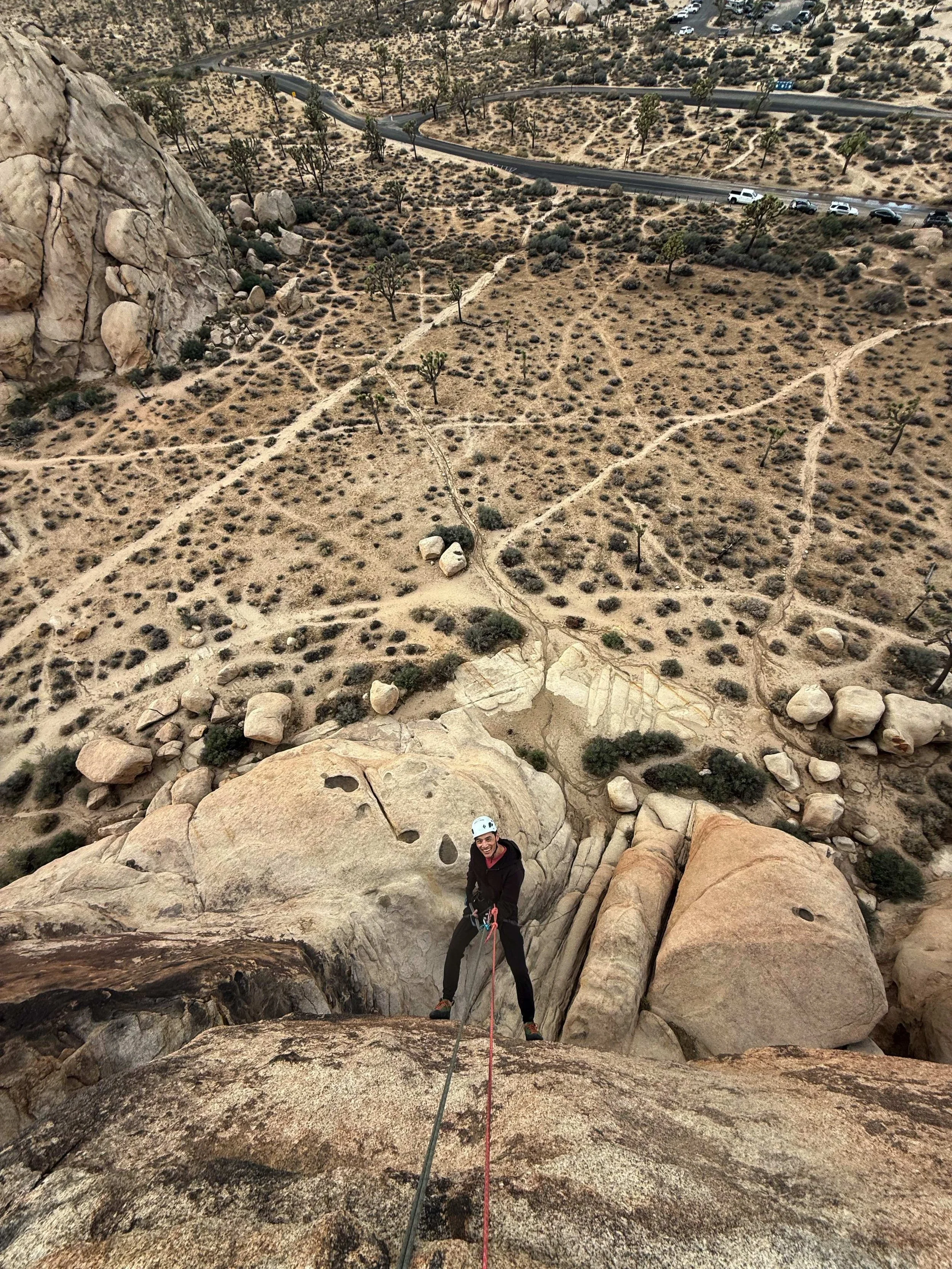
What You'll Experience on a Guided Rappelling Adventure
Every rappelling adventure with Summit is private — just your group and your guide. No strangers, no merged groups, no waiting in line.
The Approach
Most of our rappelling sites require a short scramble or off-trail hike to reach. That approach is part of the experience — you're moving through backcountry terrain, reading the rock, and getting a feel for the park in a way you can't from a maintained trail. By the time you reach the top of the rappel, you've already earned the view.
Rope Skills and Setup
Your guide walks you through how the system works before you ever leave the ground. You'll learn what you're descending on, how the friction device controls your speed, what to do if you want to pause mid-rappel, and how to communicate with your guide. Understanding the system — not just following instructions — is what makes the experience satisfying rather than just nerve-racking.
The Descent
You back up to the edge. You lean back into the harness. And you go. Most first-timers spend the first fifteen feet fighting the urge to grab the wall. By thirty feet, they're trusting the system. By the bottom, they're asking if they can go again.

Building on It
Rappelling rarely happens in isolation on our trips. Many guests combine it with a Caves & Corridors Adventure, a guided rock climbing session, or one of our custom Adventure Routes for a full day in the park. If you're booking a longer trip, ask about pairing options.
Who Is Rappelling Right For?
We get this question a lot, and the honest answer is: almost anyone who wants to try it. We've guided rappelling adventures for guests ranging from 7 years old to well into their 70s. We've worked with people who described themselves as terrified of heights — who then did three rappels in a row and didn't want to stop.
What matters more than experience level:
- You want to try it. Nervous is fine. Being talked into it by someone else is less ideal. Guides can help with nerves; they can't manufacture motivation.
- You're in reasonable physical shape. You don't need to be an athlete — but you need to walk uneven terrain, wear a harness, and hold yourself against a rock face. Most healthy adults and kids are fully capable.
- You can take direction. The guide manages your safety. Your job is to listen, ask questions, and follow the system.


Beginner vs. Advanced: Choosing Your Level
We tailor every rappelling adventure to the group in front of us. Here's what different experience levels typically look like:
No Experience Required
- Ground instruction before any vertical terrain
- Shorter rappels sized to build confidence
- Patient pacing — no rush, ever
- Emphasis on understanding the system
- Ideal for families and first-timers
Push It Further
- Longer, more exposed descents
- Multiple rappels in a single outing
- Combined with scrambling between rappels
- Technical terrain and route variety
- Tell us your experience when booking

Essential Gear — All Provided
You don't need to own anything. All technical equipment is included on every Summit rappelling trip:
- Helmet — mandatory on every trip, worn by every guest and guide
- Harness — professionally fitted before any vertical terrain
- Rope — modern dynamic rope rated well beyond the loads of guided trips
- Rappel device and locking carabiner — selected by your guide for the route and your experience level
- Backup safety system — redundant belay is standard practice on every rappel, not an optional extra
Footwear: Closed-toe shoes with solid grip. Hiking boots or trail runners work well. Sandals are a hard no. Clothing: Long pants are recommended — the granite is abrasive against bare skin. Water: Enough for the full duration of your outing. Pack: Leave the big backpack in the car — a waist pack or pockets is all you need.
Safety: What Our Guides Manage So You Don't Have To
Rappelling is a vertical activity. Vertical activities involve real risk — and real risk requires real management. Here's what Summit's guides handle on every trip:
- Anchor building. Every anchor is built by a certified guide and checked before any guest touches the rope. Redundant anchors are standard, not a backup measure.
- Equipment inspection. Every piece of gear is inspected before each use — helmets, harnesses, carabiners, ropes, and devices checked by the guide prior to every outing.
- Backup belay. Every guest is backed up on rappel. The guide manages the backup system independently — if anything unexpected happens, it's caught before it becomes an incident.
- Communication protocols. Clear signals are established before any guest starts descending. You always know when to stop, when to go, and when your guide is ready.
- Weather monitoring. We monitor conditions and make route decisions based on what we see, not what the schedule says.
Rappelling with Summit means the technical risk management is entirely off your plate. Your job is to enjoy the descent.

Best Time of Year for Rappelling in Joshua Tree
Joshua Tree sits at 4,000–5,000 feet elevation — significantly cooler than the desert floor below. There's no month we won't guide rappelling here, but here's how the seasons break down:
Ideal. Moderate temperatures, stunning afternoon light, and crowds starting to thin. One of our favorite times to guide.
Cold in the mornings, often beautiful mid-day. Clear skies, sharp air, almost no crowds. Dress in layers — the top of a rappel with wind can get cold fast.
Peak season. Ideal temperatures, wildflowers in a good rain year, and the busiest time in the park. Book early for spring trips.
Hot, but manageable with early-morning starts. Our backcountry locations catch shade and breeze that the main areas don't. Typically done before noon.
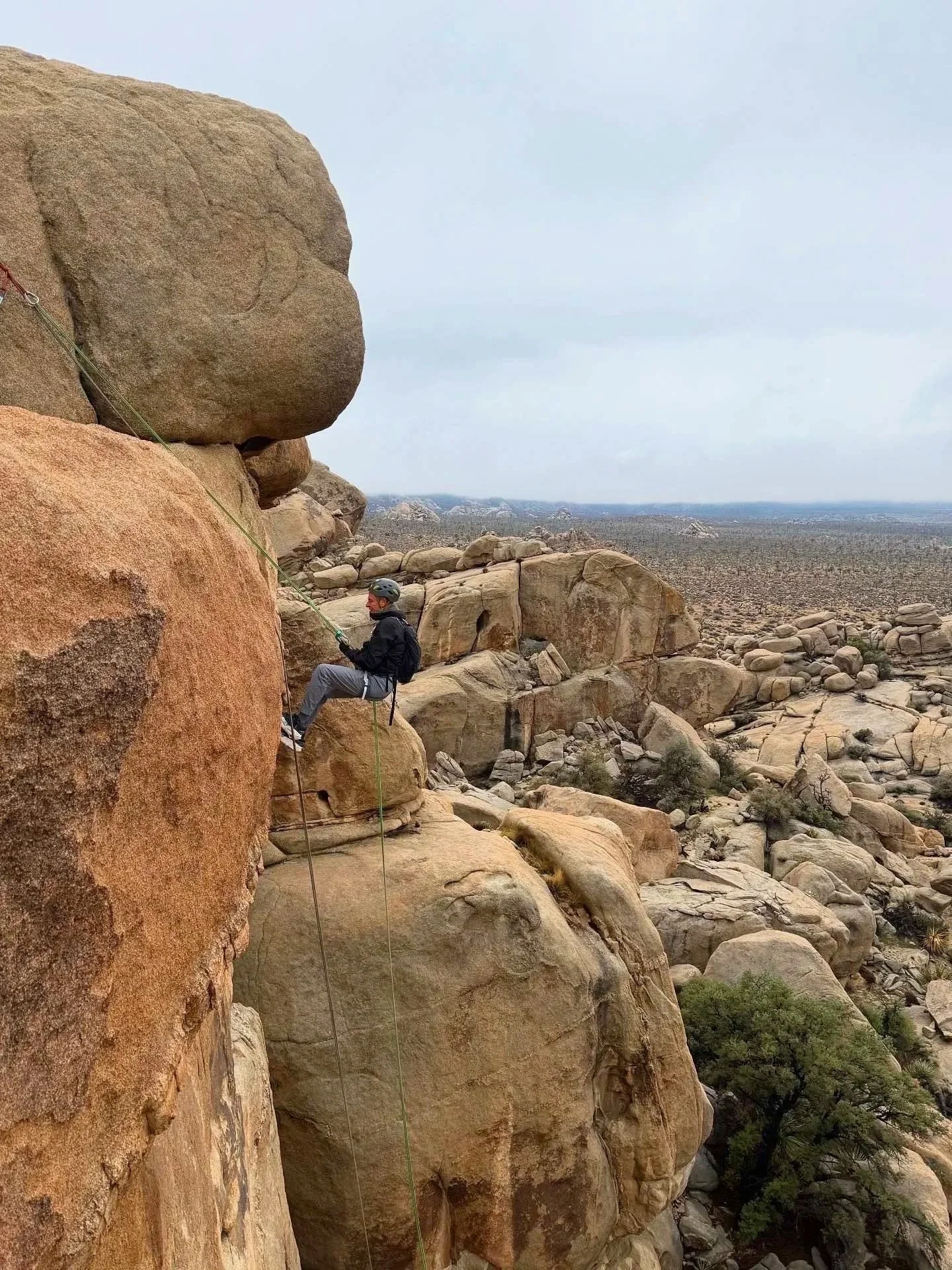
Rappelling vs. Rock Climbing vs. Adventure Routes
We get asked this constantly from guests trying to figure out which Summit experience is right for them. Here's the straightforward comparison:
Many guests do multiple activities across a trip — rappelling in the morning, Adventure Routes in the afternoon, or a guided rock climbing day followed by cave exploration. We can help you build a Joshua Tree program that makes the most of your time.

Frequently Asked Questions
Do I need prior rappelling experience?
What if I'm afraid of heights?
What is the minimum age for rappelling?
How high are the rappels in Joshua Tree?
Can rappelling be combined with other activities?
Is all the gear provided?
Do you guide rappelling year-round?
What makes Summit different from going on my own or with another guide service?