Solo Travel at Joshua Tree: The Complete Guide for 2026
There's a particular quality to a place you experience alone — no negotiation, no compromise, just you and the landscape. Joshua Tree is one of the best places in Southern California for exactly that kind of trip. Solo travel at Joshua Tree has grown steadily in recent years, and for good reason. The park rewards curiosity and slow movement — both things that a solo traveler can do on their own terms.

There's a particular quality to a place you experience alone — no negotiation, no compromise, just you and the landscape. Joshua Tree is one of the best places in Southern California for exactly that kind of trip.
Solo travel at Joshua Tree has grown steadily in recent years, and for good reason. The park rewards curiosity and slow movement — both things that a solo traveler can do on their own terms. This guide covers everything: safety, logistics, the best solo-friendly activities (including guided adventures that work perfectly for single travelers), photography, where to stay, and how to make the most of a trip you don't have to plan around anyone else's preferences.
- Why Joshua Tree Is Excellent for Solo Travel
- Solo Safety Essentials
- Guided Adventures for Solo Travelers
- Best Self-Guided Solo Experiences
- Solo Photography at Joshua Tree
- Where to Stay as a Solo Traveler
- Best Time of Year to Visit Solo
- Essential Logistics
- Frequently Asked Questions
- Book a Solo Adventure
Why Joshua Tree Is Excellent for Solo Travel
Solo travel works best in places that reward your own pace, welcome your full attention, and don't require a partner to be safe or meaningful. Joshua Tree checks all three.
You Move at Your Own Speed
Stopping for twenty minutes at a boulder because the light is doing something interesting. Turning around on a trail because you'd rather sit and read in the shade. Extending an evening in the park until the last light disappears and the stars appear. Solo travel at Joshua Tree means every decision is yours — and the park is patient enough to reward that freedom.
The Landscape Gives You Something to Think About
One of the underrated benefits of a solo desert trip is what happens internally when you remove the usual noise. Joshua Tree is quiet in a way that most environments aren't. The scale of the landscape — 800,000 acres of granite and desert sky — has a way of rearranging things. Many solo travelers describe their Joshua Tree trips as some of the most clarifying time they spend each year.
It's a Strong Solo Photography Destination
Solo travel and photography go naturally together, and Joshua Tree is one of the best photography destinations in the American Southwest. The granite formations, Joshua tree silhouettes, desert light at golden hour, and dark skies after nightfall provide constant subject matter without requiring another person in the frame.
Guided Adventures Are Designed for Solo Travelers
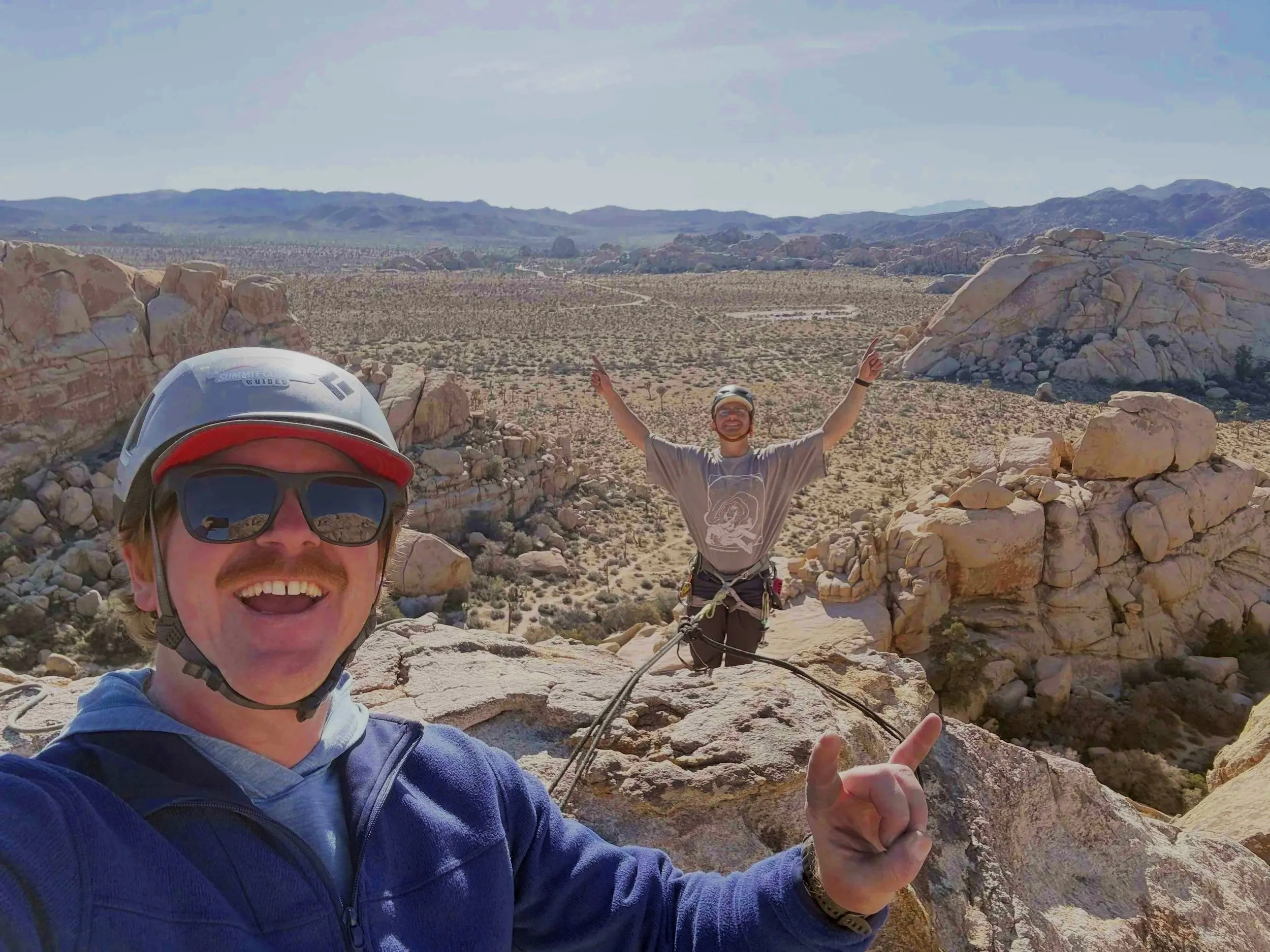
This is something many solo travelers don't realize: Summit's guided adventures are private, one-on-one experiences. You don't need a partner. You don't get paired with strangers. A solo guided trip is just you and your guide — rappelling, climbing, or exploring — with the entire experience calibrated to what you want to do.

Solo Safety Essentials
Joshua Tree is a genuinely safe destination for solo travelers with appropriate preparation. The risks are real but predictable: heat, dehydration, and navigation. All three are manageable.
Water
Carry a minimum of one gallon per person per day in summer. In spring and fall, no less than two liters for any hike over two hours. Dehydration is the most common medical issue in the park — and it develops faster in desert heat than most people expect.
Offline Maps
Cell service is unreliable to nonexistent inside the park. Download AllTrails or CalTopo offline before you arrive. The park map available at the entrance is also excellent — keep a paper copy in your car.
Tell Someone
Leave your itinerary — trailheads, expected return time, where you're staying — with someone at home. If you don't come back when expected, they need to know where to start looking. This is non-optional for solo backcountry travel.
Heat Windows
In summer, avoid strenuous activity between 10am and 4pm. Start hikes before sunrise. The desert feels deceptively manageable when there's a breeze — shade temperature and sun temperature differ significantly.
Gas & Food
There are no gas stations inside the park. Fill your tank before entering — the nearest stations are in Joshua Tree town and Twentynine Palms. Pack more food than you think you need and keep it in a cooler.
Stick to Marked Trails Solo
Unless you have strong backcountry navigation skills, stay on established trails when hiking alone. The boulder terrain looks similar in every direction and is easy to get turned around in off-trail.
Joshua Tree National Park dispatch: (760) 367-5500. Save it before you lose cell service. In the park, the best phone signal is near the entrance stations and the visitor center — not in the boulder formations.
Guided Adventures for Solo Travelers
Booking a guided adventure is the single best thing a solo traveler can do at Joshua Tree. It eliminates the safety concerns of solo climbing and rappelling, it accesses terrain most visitors never find, and it gives you five or six hours with someone who knows the park better than anyone. It's also simply a much better day than most solo travelers manage on their own in the backcountry.
Rappelling for One
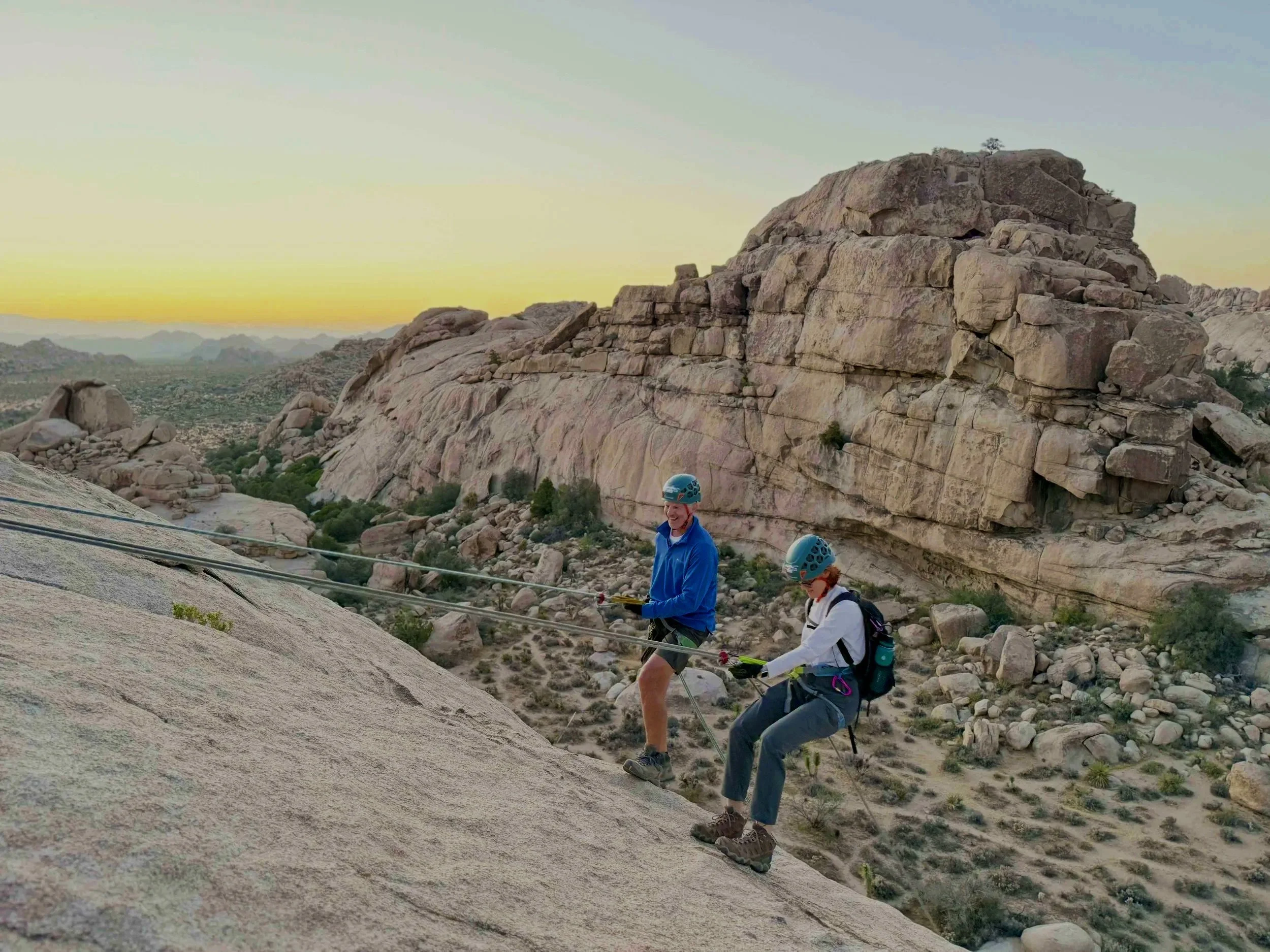
Summit's rappelling tours work perfectly for solo travelers. All anchors are set and managed by the guide, the rope system is top-rope (meaning a mistake doesn't mean a fall), and the pace is entirely yours. Solo rappellers often find the experience more meditative and focused than group trips — just you, the rock, and the desert below.
Rock Climbing for Beginners
If you've never climbed before, a beginner rock climbing session with a private guide is the ideal solo introduction. No partner required. The guide coaches you one-on-one, which means you progress faster than you would in a group lesson — and you spend the day on routes chosen specifically for you.
Hall of Horrors & Caves and Corridors
Both the Hall of Horrors scramble and the Caves and Corridors tour are guided, no-rope experiences ideal for solo travelers who want to move through the granite landscape without the commitment of a full climbing day. Both are accessible to a wide range of fitness levels and lead to terrain that takes most visitors years of repeat trips to find independently.

Best Self-Guided Solo Experiences
Outside of guided adventures, Joshua Tree offers a remarkable range of solo-friendly experiences that require nothing more than a park entrance fee and a pair of hiking shoes.
Barker Dam Trail (1.3 miles, flat)
The most consistently beautiful short hike in the park. The trail winds through a boulder landscape to a small reservoir that reflects the surrounding rock formations when there's water. Golden hour is the best time to be here — the light on the granite and the water surface is exceptional. Roadrunners and other wildlife are commonly spotted.
Skull Rock Nature Trail (1.7 miles)
A loop trail through the namesake boulder landscape, passing Skull Rock and several excellent spots to sit alone with the desert. Best in morning light or at dusk — the rock formations cast long shadows that are almost completely different from their midday appearance.
Ryan Mountain (3 miles, 1,000 ft elevation gain)
The most rewarding day hike in the park for solo travelers who want a genuine workout and a summit view. The 360-degree panorama at the top — across the Pinto Basin and out to the San Jacinto Mountains — is worth the climb. Go early to have the summit to yourself.
Keys View (Drive-Up)
The best panoramic viewpoint in the park, accessible by car. At sunrise or sunset, the view stretches from the San Jacinto Mountains across the Coachella Valley to the Salton Sea. One of the most photographed spots in the park — go on a weekday or at dawn to have space.
Cholla Cactus Garden
A short boardwalk through one of the densest stands of teddy bear cholla cactus in the park. At sunrise, the backlit spines glow in a way that's genuinely hard to photograph badly. Almost always uncrowded in the early morning.
Solo Photography at Joshua Tree
Joshua Tree is one of the great photography destinations in the American Southwest, and solo travel is in many ways the ideal way to photograph it. You're not waiting on anyone. You can stay at a location as long as the light holds. You can arrive before sunrise without coordinating with another person. The park rewards patience and return visits in a way that feels more achievable when you're traveling alone.
Golden Hour
The light at Joshua Tree during the hour after sunrise and the hour before sunset is extraordinary — warm, low-angle, and strong enough to pull out every texture in the granite. The Skull Rock area, Hidden Valley, and the open desert along Pinto Basin Road are all excellent during this window.
Night Sky Photography
Joshua Tree is one of the closest true dark-sky destinations to Los Angeles. On new moon nights, the Milky Way appears overhead as a dense band of light that most photographers from Southern California cities have rarely or never captured. Pull off anywhere away from the main park road, wait 20 minutes for your eyes to adjust, and point your camera up.
For Milky Way photography: shoot between midnight and 4am (depending on season), use a wide-angle lens at f/2.8 or faster, ISO 3200–6400, and 15–25 second exposures. The Jumbo Rocks area offers the best foreground granite formations for composed night shots.
Self-Portrait Tips for Solo Travelers
If you want yourself in the frame: a tripod is essential, a remote shutter release makes it easier, and interval mode (where the camera fires automatically every 2–3 seconds) lets you get into position without rushing. The wide granite faces and open ridgelines at Joshua Tree give you space to compose a natural-looking self-portrait without needing another person.

Where to Stay as a Solo Traveler
Camping Inside the Park
The classic solo option — and genuinely the best way to experience Joshua Tree if you're comfortable outdoors. Camping inside the park at Jumbo Rocks or Ryan campground puts you directly in the landscape. You wake up with the boulders. You have the trails to yourself before 8am. The stars are overhead as you fall asleep. Walk-up sites are available at several campgrounds (check current availability at Recreation.gov), but weekend sites at the popular campgrounds fill quickly — reserve well in advance for spring and fall.
Joshua Tree Town (Budget to Mid-Range)
The town of Joshua Tree has several boutique hotels, motel-style lodges, and Airbnbs that attract an outdoorsy, creative crowd — the kind of place where solo travelers tend to meet interesting people at breakfast. The weekend itinerary guide has more detail on the town and what's worth stopping for.
Yucca Valley (More Options, Slightly Farther)
Yucca Valley, 10–15 minutes from the park's west entrance, has the most accommodation options in the area — including larger hotels with pools and a range of vacation rentals. A good base if you're staying multiple nights and want more amenities between park days.
Private Vacation Rentals
If budget allows, a private desert rental — even for one person — is an exceptional way to experience the area. Many properties have hot tubs, fire pits, and open desert views. After a long day in the park, returning to a private outdoor space under dark skies is one of the best ways to end a solo day in the desert.
Best Time of Year to Visit Joshua Tree Solo
For the complete month-by-month breakdown, see our best time to visit Joshua Tree guide. Here's the solo-specific version:
| Season | Temps | Crowds | Best For Solo |
|---|---|---|---|
| Feb – Apr Peak |
50–80°F | High | Wildflowers, photography, climbing — best overall conditions, more crowded trailheads |
| May | 60–95°F | Moderate | Shoulder season — good conditions early in month, heat builds toward June |
| Jun – Sep | 85–105°F+ | Low | Dark skies, empty park, early morning hiking — requires heat planning |
| Oct – Nov Best |
55–85°F | Moderate | Ideal for solo travel — good temps, thinning crowds, exceptional stargazing |
| Dec – Jan | 35–65°F | Low | Very quiet park, crisp desert air, beautiful winter light — dress in layers |
October and November are our top recommendation for solo travelers. The park is quieter than spring, temperatures are ideal for active days, and new moon nights in fall produce some of the year's best stargazing.
Essential Logistics for Solo Visitors
Park Entrance
$35 per vehicle, $20 per person if you're entering on foot, motorcycle, or bicycle. The America the Beautiful annual pass ($80) covers entrance fees at all national parks for 12 months and pays for itself in two visits.
Cell Service
Unreliable to nonexistent inside the park. Download your maps offline before you arrive (AllTrails or CalTopo). Keep the paper park map from the entrance station in your car — it shows all campgrounds, trailheads, and facilities clearly.
Gas
No gas inside the park. Fill up in Joshua Tree town (west entrance) or Twentynine Palms (north entrance). The park is bigger than it looks on a map — budget for the drive time between trailheads.
Getting There
Joshua Tree is approximately two hours from Los Angeles and three hours from San Diego. From LA, the most direct route is the 10 East to the 62 North, entering through the town of Joshua Tree. Parking is free at all trailheads inside the park.
What to Pack
- Water — minimum 1 gallon/day, more in summer
- Sunscreen and a hat — desert UV exposure is intense even in cooler months
- Layers — temperature swings between day and night can exceed 30–40°F
- Headlamp with extra batteries for after dark
- Offline map and paper park map backup
- First aid kit and emergency whistle
- Snacks and more food than you expect to need
Frequently Asked Questions
Is Joshua Tree safe for solo travelers?
Is Joshua Tree good for solo travel?
Is rock climbing safe for solo beginners?
What are the best solo activities at Joshua Tree?
Can I do a guided adventure alone?
Where do solo travelers stay at Joshua Tree?
Is Joshua Tree good for solo photography?
What should I know before visiting alone for the first time?