Gram Parsons and Joshua Tree: The Story Behind the Desert Connection

For most visitors, Joshua Tree National Park is about the rocks, the sky, and the silence. But for a certain kind of music fan, the park carries an extra layer — the ghost of Gram Parsons, the man who more or less invented country rock, and who spent his last years making the desert his home.
This is not a morbid story, though it has dark chapters. It's a story about a musician who found something true in this landscape and kept coming back to it — and whose connection to Joshua Tree now draws visitors from around the world who want to feel what he felt.
Who Was Gram Parsons?
Gram Parsons was born Cecil Ingram Connor III in 1946 in Winterhaven, Florida — a life of Southern privilege and early tragedy that would shape everything he later wrote. By the time he arrived in Los Angeles in the late 1960s, he had already played with the International Submarine Band and briefly with The Byrds, where he pushed the band toward country in ways that divided critics and audiences alike.
His masterwork came with the Flying Burrito Brothers and then two solo albums — GP (1973) and Grievous Angel (1974, released posthumously) — that stand today as the foundation of country rock and Americana. Emmylou Harris, who sang with him on those records, said he taught her to hear music differently. He was 26 when he died.
The Joshua Tree Connection
Parsons discovered the Hi-Desert in the early 1970s through his friend and road manager Phil Kaufman. The two would drive out from Los Angeles for days at a time, camping in the desert, driving dirt roads, and staying at the Joshua Tree Inn — a small motel on Route 62 that became Parsons' desert base.
People who knew Parsons describe Joshua Tree as the place he exhaled. The city, the industry, the pressure of being a musician who didn't fit any category — the desert burned all of it off. He called Joshua Tree "the place where heaven and earth come closest."
Whether he actually said that or whether it became legend after his death is hard to say. What's clear is that he kept returning, and that the landscape shows up in the emotional texture of his music — vast, aching, and impossible to pin down.
September 1973: What Happened at the Joshua Tree Inn
On September 19, 1973, Gram Parsons was found unresponsive in Room 8 of the Joshua Tree Inn. He was 26 years old. The cause of death was a morphine overdose, compounded by alcohol. He had been on a brief desert retreat before a scheduled tour.
What followed his death became one of rock and roll's strangest stories. His road manager Phil Kaufman and a friend named Michael Martin intercepted Parsons' body at Los Angeles International Airport before it could be flown to Louisiana for burial. They drove it back to Joshua Tree, out to Cap Rock in what is now the park, and attempted to cremate it — per what they claimed were Parsons' own wishes. The improvised ceremony was only partially successful. Kaufman and Martin were later fined $750 — for stealing the coffin. There was no law against stealing a body.
The Places Connected to Parsons in the Area
The Joshua Tree Inn
Still operating as a boutique motel on Route 62 in Joshua Tree. Room 8 — where Parsons died — is bookable and frequently requested by fans making a pilgrimage. The inn leans into its history without being exploitative about it.
Cap Rock
The formation in the park where Kaufman and Martin attempted the cremation. It's accessible via a short loop trail off Keys View Road. There's no formal marker — but fans leave offerings: flowers, photos, guitar picks, handwritten notes.
Pioneertown & Pappy & Harriet's
The honky-tonk roadhouse that Parsons loved for its combination of desert isolation and live music. Pappy & Harriet's still operates today and remains one of the finest small music venues in the American West.
Gram Parsons Guitar Pull
A memorial concert held annually near the anniversary of his death, typically at Pappy & Harriet's. Musicians gather to play his songs and the music he loved. Low-key, sincere, and worth planning a trip around if dates align.
His Musical Legacy
Gram Parsons didn't live long enough to be famous. He died before either of his solo albums found their audience, before country rock became mainstream, before the Eagles (who absorbed his ideas wholesale) sold a hundred million records. He is one of those artists whose influence arrived without him.
Emmylou Harris went on to a career that spanned decades and kept Parsons' songs in rotation. Keith Richards, who became close friends with Parsons in the early 1970s, has cited him as a major influence. Ryan Adams, Wilco, Beck, and countless others have pointed back to Grievous Angel as a touchstone.
The Cosmic American Music he described — a blending of country, soul, rock, and gospel without genre boundaries — is now so embedded in American music that it's hard to hear the original clearly. But put on Return of the Grievous Angel or Brass Buttons in the desert at dusk and it snaps back into focus fast.
What to Do If You Want to Honor the Connection
A Gram Parsons pilgrimage to Joshua Tree doesn't have to be somber. Here's a loose itinerary:
- Stay at the Joshua Tree Inn — even if you don't get Room 8, the inn has the right atmosphere. The owners are thoughtful about the history.
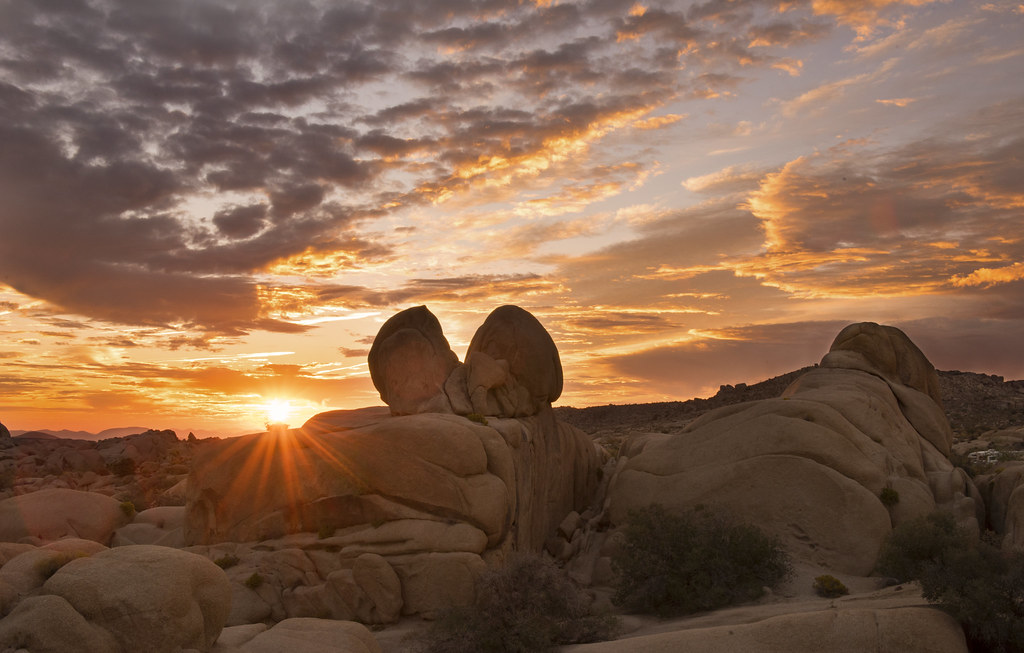
- Drive to Cap Rock early morning or at sunset — the light is extraordinary and the formation itself is worth seeing independent of its history.
- Eat at Pappy & Harriet's — the drive to Pioneertown is half the point. Check their calendar for live music nights.
- Listen to Grievous Angel in the park — ideally in the Wonderland of Rocks area at dusk, windows down. It was written for exactly this landscape.
The Myth and the Man
There's a version of Gram Parsons that has become pure desert mythology — the doomed visionary, the rock and roll martyr, the man the desert claimed. That version is seductive and not entirely wrong.
But the more interesting version is just the music. He was working toward something genuinely original, something that took the emotional directness of country music and the electric energy of rock and refused to choose between them. He didn't get enough time to finish the project.
Joshua Tree was where he went to think. The boulders, the silence, the brutal honesty of the desert at night — it shows up in the work. If you listen closely enough out there, you can almost hear it back.
Want to experience the desert he loved? See our guided experiences →
Experience the Desert That Inspired Him
Summit's guided climbing, cave, and adventure experiences take you deep into the landscape Gram Parsons called home. All experience levels welcome.
Book a Guided Experience