Stargazing at Joshua Tree: The Complete Guide to the Desert's Dark Skies

Most people visit Joshua Tree for the boulders. They stay for the sky.
Joshua Tree National Park is a designated International Dark Sky Park — one of only a handful in California — where light pollution is actively controlled and the night sky looks the way it did before electricity. The Milky Way appears as a dense band of light. Thousands of stars are visible that most people have never seen from a city. And two hours from Los Angeles, this is as dark as Southern California skies get. This guide covers everything: where to go, when to go, what you'll see, what to bring, and how to make a full trip out of it.
Why Joshua Tree for Stargazing
Joshua Tree National Park sits at the convergence of the Mojave and Colorado Deserts in the high desert of Southern California, at elevations between 1,000 and 5,000 feet. The combination of altitude, dry desert air, distance from major urban centers, and active light pollution controls gives it night skies that rank among the darkest in the state.
The park earned its International Dark Sky Park designation from the International Dark-Sky Association (IDA) — a recognition that requires documented sky quality measurements, the installation of shielded lighting throughout the park, and an ongoing commitment to preserving darkness. In practical terms, it means the park's interior consistently achieves Bortle Class 2–3 conditions — the level at which zodiacal light, airglow, and the full structure of the Milky Way become visible to the naked eye.
For visitors from Los Angeles, Orange County, or San Diego — where Bortle Class 8–9 skies are the norm — the difference is not subtle. You will see things overhead that most Southern Californians have never seen.
The Bortle Scale rates sky darkness from 1 (darkest possible) to 9 (inner-city sky). Los Angeles is a 9. Joshua Tree's darkest areas reach Bortle 2–3 — the level at which the Milky Way casts a visible shadow and thousands of stars are naked-eye visible. That's not an incremental improvement. It's a different sky entirely.
What You'll See
What's visible on any given night depends on moon phase, season, and your location in the park. Here's what to look for:
The Milky Way
The core of the Milky Way — the densest, brightest central band — is visible from late March through October, peaking in July and August when it arcs directly overhead. On a new moon night with clear skies, it appears as a luminous river of light spanning the entire sky, with visible dust lanes and star-forming regions to the naked eye. Outside of peak season, the galactic plane is still visible but the core is below the horizon.
Stars & Deep Sky Objects
Under Bortle 2–3 skies, expect to see 2,000–4,500 individual stars without any optical aid — compared to roughly 200–300 from a typical suburban yard. The Andromeda Galaxy (M31) is visible to the naked eye as a faint smudge. The Pleiades star cluster resolves into individual members. Star clusters, emission nebulae, and satellite galaxies become accessible with even basic binoculars.
Planets
Planets are visible year-round regardless of moon phase. Venus, Mars, Jupiter, and Saturn are frequently bright enough to be obvious without any equipment. Check a free app like Stellarium before your visit to know what's up — a bright "star" that doesn't twinkle is almost certainly a planet.
Satellites & the ISS
The International Space Station makes regular passes visible from Joshua Tree — a steady, bright point moving steadily across the sky over 3–5 minutes. NASA's Spot the Station tracker gives pass times for your exact location.
Best Stargazing Spots in the Park
Any location away from the park entrances and the Twentynine Palms Highway offers good skies. Darker areas are deeper into the park or in the southern Cottonwood section. Here are the top specific spots:
Skull Rock Pullout
Easy roadside access off Park Blvd, flat ground, and a wide open horizon. One of the most accessible spots for first-time stargazers and groups. Close enough to the road to be convenient, far enough into the park for excellent skies.
Keys View
The park's highest accessible viewpoint at 5,185 feet — above some of the valley haze. 270-degree horizon overlooking the Coachella Valley. The elevation and panoramic exposure make it exceptional for both sunset and stars. Drive-up accessible.
Cottonwood Area (South)
The Cottonwood section in the park's south end is its darkest — furthest from Palm Springs, Indio, and Twentynine Palms light domes. Cottonwood Campground and the Cottonwood Springs area are the go-to for serious dark sky observers.
Cholla Cactus Garden
A flat, open stretch of transition zone between the two deserts. The low profile of the cholla cacti means unobstructed horizon in every direction — ideal for watching the Milky Way rise or tracking objects as they move across the sky.
Barker Dam Parking Area
A large pullout near Hidden Valley with granite formations silhouetted against the sky — adds visual drama to your stargazing. The surrounding boulders block wind without obstructing overhead sky. Popular with photographers for this reason.
Any Desert Roadside Pullout
Don't overthink it. Any pullout on Park Blvd between Skull Rock and Cottonwood with your headlights off will give you extraordinary skies. Drive until you're away from other cars, stop, look up.
The park closes to new vehicle entry after the entrance gates are staffed for the night, but if you're already inside or enter during the day and stay, you can stargaze as late as you want. Day-use areas remain accessible through the night with a valid park pass. Campground residents have full overnight access.
Best Time of Year for Stargazing at Joshua Tree
| Season | Milky Way Core | Temperature | Sky Clarity | Verdict |
|---|---|---|---|---|
| Jan – Feb | Not visible | Cold (30s–50s°F) | Excellent | Best star density, winter constellations, low humidity |
| Mar – Apr | Rising (late) | Mild (50s–70s°F) | Excellent | Best all-around window — comfortable and clear |
| May – Jun | Excellent | Warm–Hot (70s–90s°F) | Very Good | Milky Way core rising — good for astrophotographers |
| Jul – Aug | Peak | Hot (80s–100s°F) | Good (monsoon risk) | Milky Way directly overhead, but watch for summer storms |
| Sep – Oct | Setting (early) | Mild (60s–80s°F) | Excellent | Our top recommendation — comfortable, clear, uncrowded |
| Nov – Dec | Not visible | Cold (30s–50s°F) | Excellent | Winter sky, very dark, very quiet — underrated |
Moon Phase Matters More Than Season
Whatever time of year you go, plan around the moon. A full moon rises near sunset and illuminates the sky all night — washing out fainter stars, the Milky Way, and deep sky objects. A new moon means total darkness from dusk to dawn. New moon ± 3 days is the ideal window. Check the lunar calendar before booking.
Best Time of Night
The darkest window of any night follows a simple pattern: the later you stay, the darker it gets — up to a point.
- 90 minutes after sunset: Astronomical twilight ends and true darkness begins. This is your earliest realistic start time for serious stargazing.
- Dark adaptation: Your eyes need 15–20 minutes to fully adjust after any white light exposure. Use a red-light headlamp only. Avoid checking your phone with screen brightness on.
- Best window: 9pm–1am on a moonless night typically offers the best combination of darkness, temperature, and Milky Way position (depending on season).
- Midnight onward: Atmospheric turbulence decreases after midnight, improving clarity and fine detail in telescopic viewing.
- Pre-dawn: If you're targeting specific winter or spring objects, arriving before dawn can give you a second dark window after any moon has set.
This matters more than most people expect. A single white flashlight glance resets your dark adaptation back to zero — a 20-minute process. Red light preserves night vision because the eye's rod cells (responsible for low-light vision) are insensitive to red wavelengths. Get a red-mode headlamp, or cover a regular headlamp with red cellophane. Every serious stargazer in the park will thank you.
What to Bring Stargazing at Joshua Tree
Optional but worth it
- A reclining camp chair or sleeping pad for horizontal viewing
- A thermos of something warm — coffee, tea, hot chocolate
- A car charger to keep your phone alive through a long session
- A planisphere or printed star chart (doesn't run out of battery)
- A small telescope if you're serious — a 6" Dobsonian fits in most cars and transforms the experience
What NOT to bring
- White flashlights of any kind (use red only)
- Bright phone screens not set to night/red mode
- Loud speakers — sound carries in the desert and other stargazers are listening to the silence intentionally
Meteor Showers at Joshua Tree
Joshua Tree's dark skies make it one of the best places in Southern California to watch meteor showers. Under Bortle 2–3 conditions, even minor showers produce noticeably more visible meteors than from the city — and major showers at peak can produce dozens of meteors per hour to the naked eye.
Key Meteor Showers by Month
- Quadrantids (early January): Short but intense peak — can hit 120 meteors/hour at maximum. Cold night but spectacular.
- Lyrids (late April): Reliable mid-spring shower, 15–20 meteors/hour at peak. Good temperatures.
- Perseids (mid-August): The most popular meteor shower of the year — up to 100+ meteors/hour at peak, warm nights, and coincides with Milky Way core visibility. Plan well in advance; the park is busy.
- Orionids (late October): Swift meteors from Halley's Comet debris, 20 meteors/hour at peak. Fall temperatures make this a comfortable one.
- Leonids (mid-November): Variable year-to-year, occasionally spectacular. Worth checking in an active year.
- Geminids (mid-December): Arguably the best all-around shower — up to 120 meteors/hour, radiant is up most of the night, and the meteors are slow and bright. Cold, but worth it.
For exact peak dates and moon phase interference, the American Meteor Society (amsmeteors.org) maintains a current shower calendar.
Astrophotography at Joshua Tree
Joshua Tree is one of the most photographed dark sky locations in the American West — and for good reason. The combination of dramatic foreground (Joshua trees, granite boulders, slot formations) and dark skies overhead creates natural compositions that are difficult to replicate elsewhere in the lower 48.
Basic settings to start with
- ISO: 1600–6400 depending on your camera's noise performance
- Aperture: As wide as your lens allows — f/1.8 to f/2.8 is ideal
- Shutter speed: Use the "500 rule" — divide 500 by your focal length to get maximum seconds before stars trail. On a 24mm lens: 500 ÷ 24 = ~20 seconds.
- Focus: Autofocus doesn't work in the dark. Switch to manual focus and set to infinity (or use live view to focus on a bright star)
- White balance: 3200–4000K for a neutral sky color; experiment from there
Best foreground subjects
- Joshua trees — their silhouette is immediately recognizable and uniquely Californian
- Skull Rock and the boulder formations near Barker Dam
- The cholla cacti at Cholla Cactus Garden — backlit by moonlight they glow
- The Keys View ridge with the valley below
Camping for Stargazing at Joshua Tree
Camping inside the park puts you in the dark sky from dusk to dawn — no drive back, no headlights disrupting your session, and a chance to watch the sky rotate overhead through the night. For serious stargazers and astrophotographers, it's the clear choice.
Best campgrounds for dark skies
- Cottonwood Campground: The darkest campground in the park, farthest from town light domes. Has water and flush toilets. Reservations required most of the year.
- Jumbo Rocks: Set among dramatic boulder formations — outstanding foreground subjects for nighttime photography. Slightly more ambient light than Cottonwood but still very dark.
- Ryan Campground: Close to Ryan Mountain with excellent southern horizon views. Dry camping (no water), reservations required.
- White Tank: Small, quiet, walk-in only at some sites — one of the less-crowded options and set among photogenic granite.
All park campgrounds require reservations, especially March through May and September through November. Book at Recreation.gov at least 4–6 weeks in advance for fall and spring weekends.
Private rentals nearby
Many vacation rental properties in Joshua Tree town and Yucca Valley have open desert views, hot tubs, and fire pits — and are far enough from city cores to offer excellent skies. A private rental with an outdoor soaking tub under the Milky Way is a hard experience to top. Search Airbnb with "Joshua Tree" and filter for stargazing-specific amenities.
Pair Stargazing with a Daytime Adventure
The best Joshua Tree trips combine both halves of the day: a guided adventure in the daytime and the dark sky at night. The park's landscape that produces such dramatic climbing and scrambling terrain — open, elevated, boulder-strewn — is the same landscape that gives you unobstructed sky views after dark.
The most natural combination: a morning or early-afternoon guided adventure with Summit, then a late afternoon drive to Keys View for sunset, dinner in Joshua Tree or Yucca Valley, and back into the park after dark for stargazing. It's a full day that uses every hour well.
Guided adventures that pair well with a stargazing night
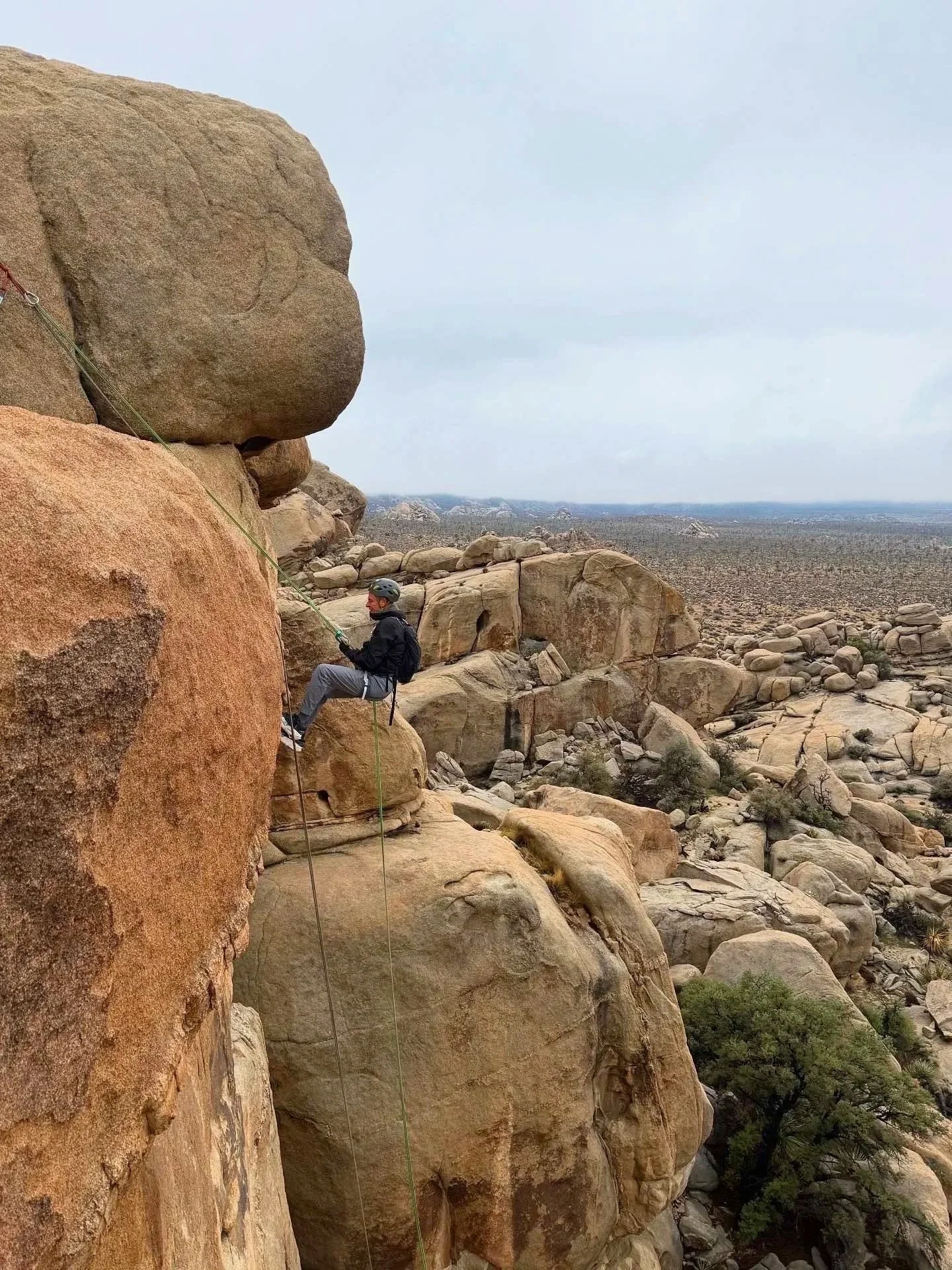
- Rappelling — a half-day format that wraps by early afternoon, leaving the rest of the day free
- Hall of Horrors Scramble — similarly timed, and physically satisfying enough that you'll appreciate a slower evening
- Caves & Corridors — the contrast between below-boulder darkness and open-sky darkness at night is something people find genuinely striking
- Adventure Routes — a full-day option that ends near sunset, with the sky waiting afterward
For a full two-day itinerary combining guided adventure and stargazing, the Joshua Tree weekend guide has a day-by-day breakdown.
Frequently Asked Questions
Is Joshua Tree good for stargazing?
What can you see stargazing at Joshua Tree?
What is the best spot for stargazing at Joshua Tree?
What is the best time of year to stargaze at Joshua Tree?
What time should I go stargazing at Joshua Tree?
Do you need a permit to stargaze at Joshua Tree?
Is Joshua Tree an International Dark Sky Park?
What should I bring stargazing at Joshua Tree?