First Time at Joshua Tree National Park: Everything You Need to Know

Joshua Tree is one of the most visually distinct places in the United States — and one of the easiest national parks to visit without any prior experience. But "easy to visit" and "easy to do well" are different things.
This guide covers everything a first-timer needs: which entrance to use, what to bring, where to go on your first day, what the park won't tell you, and how to go beyond the trails if you want a Joshua Tree experience that most visitors never have. Two hours from Los Angeles, the park is close enough to do on a whim — and rewarding enough to plan properly.
Fees, Entrances & Hours
Which Entrance to Use
West Entrance (Joshua Tree Village) — The most popular entry point and the best choice for first-timers. This entrance puts you immediately among the park's signature boulder landscapes, and close to Skull Rock, Hidden Valley, Barker Dam, and Keys View. The town of Joshua Tree just outside the gate has cafes, restaurants, and services.
North Entrance (Twentynine Palms) — The second-busiest entrance, convenient for visitors coming from the east or staying in Twentynine Palms. Slightly less dramatic first impression than the West, but accesses the same interior routes.
Cottonwood Entrance (South) — Least crowded and best for visitors coming from Palm Springs or the Coachella Valley. The southern section of the park is quieter and has the darkest skies — a good choice if stargazing is a priority.
If you visit more than two national parks per year, the America the Beautiful annual pass ($80) pays for itself immediately. It covers Joshua Tree and every other federal fee site for 12 months. Buy it at any park entrance.
What to Know Before You Go
No gas inside the park
There are zero gas stations inside Joshua Tree National Park. Fill up in Joshua Tree Village, Twentynine Palms, or Yucca Valley before entering. Running out of gas inside the park is a surprisingly common mistake — the park is large and the distances add up.
Cell service is unreliable
Assume you will have no cell service once you're inside the park. Download your maps offline before entering — Google Maps, AllTrails, or Gaia GPS all have offline download options. The visitor centers have Wi-Fi and staff if you need help with navigation.
Heat is serious
Joshua Tree sits in the high desert, where temperatures regularly exceed 100°F in summer and swing dramatically between day and night. Even in spring and fall, the sun is intense and shade is scarce. Bring significantly more water than you think you need — the NPS recommends at least 1 liter per person per hour of activity. Heat exhaustion and dehydration are the most common reasons for emergency rescues in the park.
Weather changes fast
The high desert is not the low desert — Joshua Tree's elevation (up to 5,000 feet) means cold nights even in summer, and occasional snow in winter. Check the forecast before you go and bring layers regardless of the season.
Crowds peak in spring
February through April is the busiest period — parking lots at popular trailheads fill by 9am on weekends. Arrive early, or plan to visit midweek. The park does not currently require timed entry reservations, but this can change — check the NPS website before your visit.

What to Bring to Joshua Tree
If you're joining a guided adventure with Summit, we provide all technical gear — helmet, harness, ropes, and instruction. You just need the basics above, plus comfortable clothes you can move in.
Best Things to Do for First-Timers
Joshua Tree's most rewarding spots are spread across the park. Here's a first-timer's shortlist — what to hit, in what order, and why.
Skull Rock Nature Trail
The best introduction to Joshua Tree's boulder landscape. A flat, easy loop past the park's most recognizable formation and several others. Start here on your first day.
Barker Dam Trail
A short loop to a historic water tank built by early ranchers, set among dramatic granite. Good for wildlife sightings (bighorn sheep occasional) and rock art panels nearby.
Hidden Valley
A classic loop through a natural enclosure of boulders — the kind of terrain that defines Joshua Tree. Popular with rock climbers on all sides. A must-do first visit.
Keys View
The park's best panoramic viewpoint at 5,185 feet — overlooking the Coachella Valley, San Jacinto Mountains, and Salton Sea. Drive-up accessible. Plan to arrive 30 minutes before sunset.
Cap Rock Nature Trail
Paved, flat, and fully accessible. Named for the distinctive cap-shaped boulder at its center. A good option for families with young kids or visitors with mobility considerations.
Stargazing
Joshua Tree is a certified International Dark Sky Park. On a moonless night the Milky Way is visible overhead. Pull off on any road in the park interior after dark, let your eyes adjust, and look up.
Go Beyond the Trails: Guided Adventures with Summit
Trails show you the park. Guided adventures take you through it.
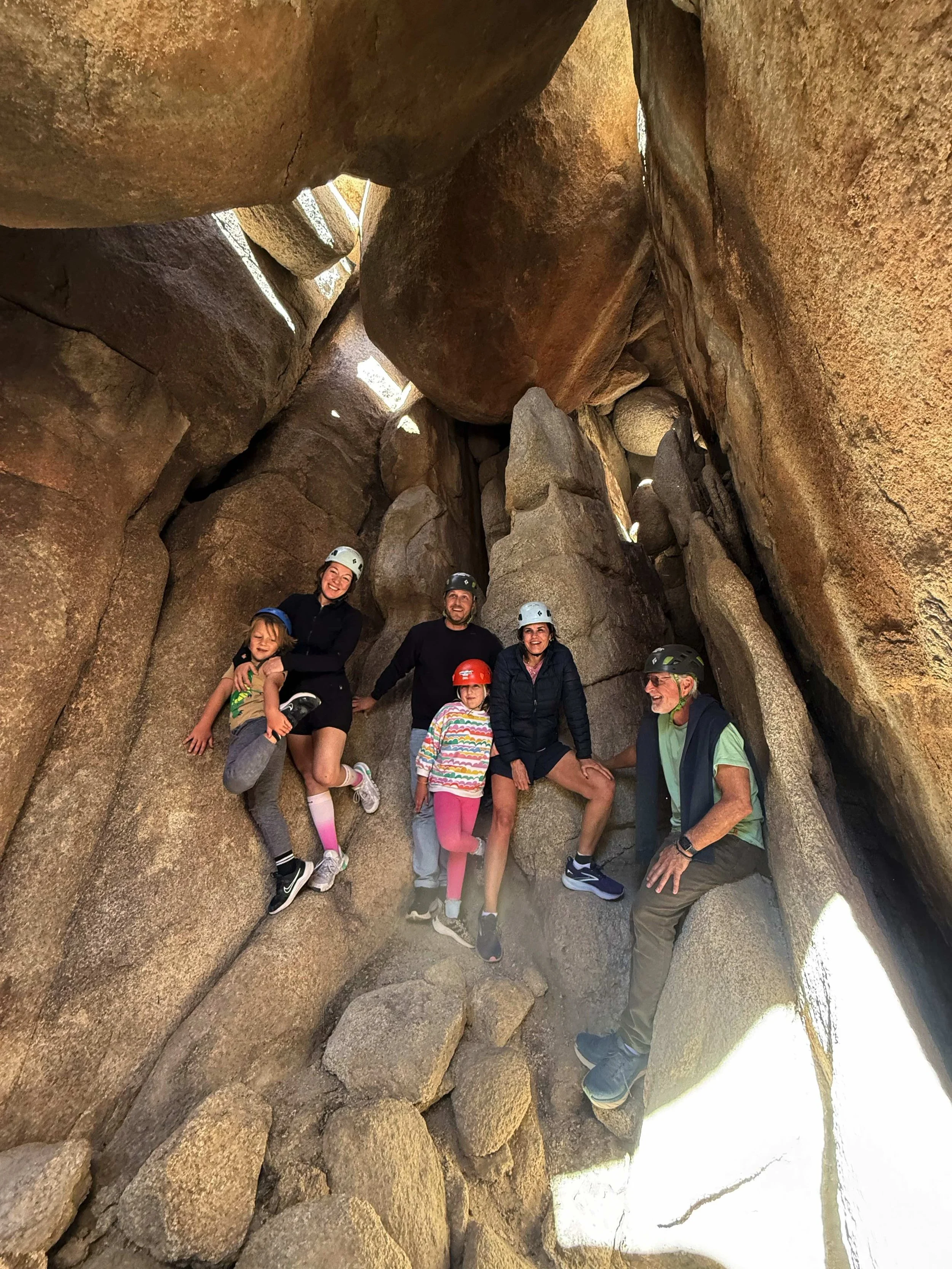
Joshua Tree's terrain — granite boulders, talus caves, hidden corridors, desert summits — is designed for movement, not just walking past. The park's most interesting places are not on marked trails. They're accessed through scrambling, route-finding, and knowing where to look. That's what a guide provides.
Summit Climbing Guides offers private guided experiences for all experience levels — including complete beginners. You don't need to know how to climb. You don't need prior outdoor experience. You just need to show up ready to move.
Best guided options for first-timers
- Rappelling — descend a granite face with full instructor support. No experience required, unforgettable for anyone.
- Hall of Horrors Scramble — move through one of Joshua Tree's most dramatic formations as a group. No ropes, no technical skills.
- Caves & Corridors — navigate above-ground talus caves and hidden rock passages that most visitors walk right past without ever noticing.
- Adventure Routes — immersive backcountry loops that combine scrambling, summits, hidden terrain, and desert views.

Where to Stay Near Joshua Tree
Camping Inside the Park
Camping puts you inside the landscape and is the most immersive way to experience Joshua Tree — especially for stargazing. Jumbo Rocks is the most popular campground for its boulder setting. Cottonwood is the darkest and quietest. All campgrounds require reservations at Recreation.gov, especially on spring and fall weekends — book 4–6 weeks ahead minimum.
Vacation Rentals (Joshua Tree & Yucca Valley)
The towns of Joshua Tree and Yucca Valley have a large selection of vacation rentals on Airbnb and VRBO — many with pools, hot tubs, and desert views. The best properties book out weeks in advance for spring weekends. A rental with outdoor space is ideal for an evening of stargazing after a day in the park.
Hotels (Yucca Valley & Twentynine Palms)
Yucca Valley has the most hotel options, including AutoCamp Joshua Tree (luxury Airstream trailers) and several standard chain hotels. Twentynine Palms has budget-friendly options near the North Entrance. Both towns are 10–20 minutes from the park's main attractions.
Where to Eat Near Joshua Tree
There is no food service inside the park — bring everything you need for the day. For meals before or after, the surrounding towns have solid options.
Joshua Tree Village
Crossroads Cafe is the classic breakfast and lunch spot — reliable, cash-friendly, consistently busy on weekends. Pie for the People has become a staple for groups. Natural Sisters Cafe for coffee and smoothies before a morning in the park.
Yucca Valley
More variety and larger portions than Joshua Tree town. Frontier Cafe is a solid dinner option. Stater Bros. grocery store for picking up supplies before camping or heading into the park.
Pioneertown
About 20 minutes from the West Entrance, Pappy & Harriet's is a legendary BBQ and live music venue in a Western movie set town. Excellent food, great atmosphere, and a uniquely Southern California experience. Book a table in advance for weekend evenings.
Best Time to Visit Joshua Tree for First-Timers
October through April covers the best conditions for a first visit. Spring (February–April) is peak season for a reason: wildflowers are possible, temperatures are ideal, and the park is at its most alive. Fall (October–November) is our personal recommendation — comfortable temperatures, thinning crowds, and exceptional stargazing.
Summer (June–September) is hot — plan any outdoor activity before 10am or after 4pm, and avoid strenuous hiking in the middle of the day. The park empties out significantly, and evenings and nights are beautiful.
Winter (December–January) is cold but strikingly quiet and beautiful. Expect near-empty trails, dramatic light, and possible snow on higher elevations.
For a full month-by-month breakdown, see our complete best time to visit guide.
Park Rules First-Timers Often Miss
- Stay on designated trails and established routes. Joshua Tree's desert soil is covered in cryptobiotic soil crust — a living biological layer that takes 50–250 years to recover from a single footstep. Step only on rock or established paths.
- No drones. Drones are prohibited throughout Joshua Tree National Park. No exceptions.
- Dogs are limited. Pets are allowed in the park but only within 100 feet of roads, campgrounds, and picnic areas. Dogs are not permitted on trails — this is strictly enforced and the reason is wildlife protection.
- Campfires only in fire rings. Ground fires are prohibited. Use only designated fire rings at designated campgrounds, and observe any fire restrictions in effect during your visit.
- Leave No Trace. Pack out all trash — there are no waste bins on trails. Leave rocks, plants, and natural features where you find them. Taking anything from the park is a federal violation.
- Wildlife viewing distance. Stay at least 50 feet from all wildlife. Feeding animals is illegal and genuinely harmful to the park's ecosystem.
Tell someone your plan. Cell service is unreliable inside the park. Before you go, tell someone your trailhead, planned route, and expected return time. The park's most common search and rescue scenarios involve visitors who went further than planned and couldn't call for help.
Frequently Asked Questions
Is Joshua Tree good for first-time visitors?
How much does it cost to enter Joshua Tree?
Which entrance should I use?
What should I bring to Joshua Tree?
How long do you need at Joshua Tree?
Is Joshua Tree easy to hike for beginners?
Is there cell service at Joshua Tree?
What are the best things to do at Joshua Tree for first-timers?