Hiking vs. Boulder Scrambling in Joshua Tree: Which Should You Do? (2026)
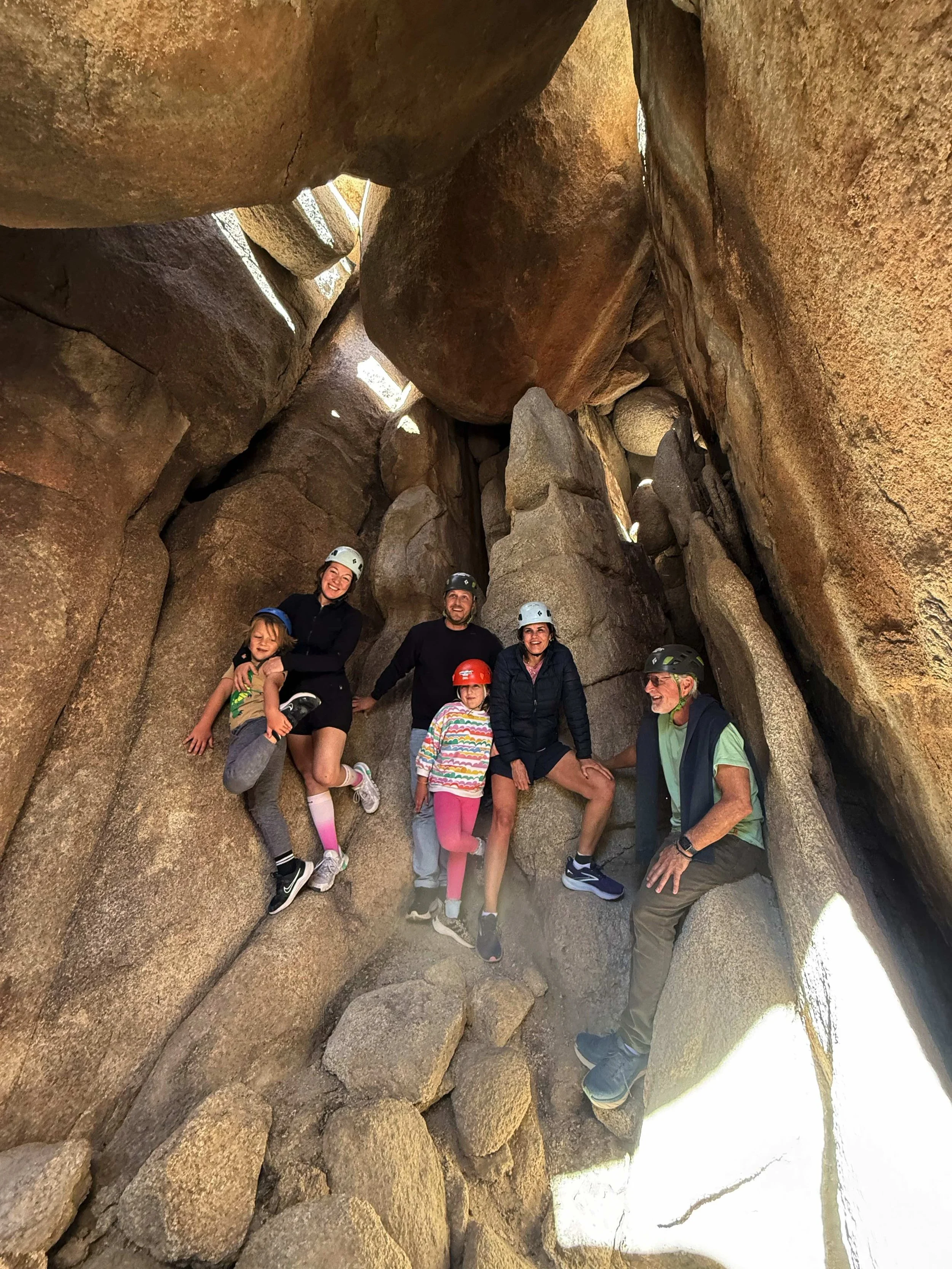
The Main Hall — one of the hidden cave systems most Joshua Tree visitors never find
What Hiking in Joshua Tree Actually Looks Like
Joshua Tree has excellent hiking. Ryan Mountain (3 miles round-trip, 1,000 feet of gain) delivers panoramic views over the entire park from its 5,461-foot summit. Barker Dam is an easy 1.3-mile loop through open desert to a quiet reservoir. Skull Rock Trail wanders through a boulder field past one of the park's most photographed formations. Lost Horse Mine is a longer 6.8-mile out-and-back with historical interest and solid views.
These are well-marked, well-maintained, and accessible to anyone in reasonable shape. You don't need a guide. You don't need gear. You show up, follow the signs, and come home with good photos and sore legs.
But here's the honest truth about hiking in Joshua Tree: you are primarily moving through the landscape, not interacting with it. You're on a trail. You're going from A to B. The granite formations you pass are impressive — but you're viewing them, not touching them, not climbing them, not squeezing between them. For many visitors, that's exactly right. For others, it turns out to be the beginning of a different conversation.

Joshua Tree's hiking trails offer excellent views — but you're moving through the landscape, not into it
What Boulder Scrambling Actually Is
Boulder scrambling means using your hands and feet to move over, through, and up rock formations. It's not rock climbing — there's no rope, no harness, no technical gear. It's not hiking — there's no trail, and you're not just walking. It sits in the space between: more physical than hiking, more accessible than climbing, and in Joshua Tree, more interesting than either.
The granite here is a scrambler's dream. Monzogranite is naturally rough and high-friction — your hands and feet stick to it instinctively even on fairly steep angles. The formations are full of natural ledges, jugs, and features that make movement feel intuitive rather than technical. Most people who try scrambling for the first time are surprised by how comfortable it feels.
The experience is fundamentally different from hiking in one key way: you're problem-solving. You're reading the rock, choosing your line, deciding whether to go left or right around a feature. You're in the landscape — physically engaged with it, rather than passing through it. That shift changes everything about how you experience the park.

Scrambling puts you on the rock, not just next to it — the difference is immediate and physical
Caves & Corridors: A World Most Visitors Never Find
If scrambling gets you into the landscape, Caves & Corridors gets you under it. Joshua Tree's boulder fields are riddled with a hidden network of caves, slot canyons, tunnels, and passages that formed as the granite cooled and cracked millions of years ago. Most park visitors walk right over the top of them. Our guides know where they are.
A Caves & Corridors adventure takes you through passages that require crawling, squeezing, chimneying, and climbing — sometimes in pitch darkness, sometimes opening into sun-lit amphitheaters that feel like secret rooms. The Hall of Horrors. The Cathedral. The Goonies Cave. These aren't on any map. They have no signs, no trails, no markers. You find them because your guide has been in them hundreds of times.
No technical gear is required. No prior experience is needed. What's needed is a genuine sense of curiosity and a willingness to get dusty. The guests who remember this adventure most vividly aren't the ones who've done the most outdoor activities — they're the ones who were most surprised by what was hidden right below a park they thought they knew.
"I've been to Joshua Tree four times. I had no idea any of this existed until today." — Guest, Caves & Corridors adventure


The Cathedral Cave (left) and a hidden rock corridor (right) — neither appears on any park map
The Experience Is Genuinely Different
Hiking gives you views. Scrambling gives you the rock itself — the texture under your hands, the exposure as you move higher, the specific satisfaction of a move that felt uncertain before you committed to it. Hiking is largely about endurance and distance. Scrambling is about engagement and presence.
The people who do Caves & Corridors don't come home talking about how far they went or how many feet they climbed. They talk about specific moments: the tunnel they had to belly-crawl through with their headlamp on. The cave that opened suddenly into a sun-flooded chamber they couldn't see coming. The ledge where the whole park stretched out below them in a direction they'd never seen before.
That's the difference. Hiking gives you a relationship with Joshua Tree from a respectful distance. Scrambling gives you a relationship with it up close — where the scale becomes personal, where the geology becomes something you're inside rather than something you're looking at. Most visitors who try both say they wish they'd done it on their first trip instead of their third.

The reaction at the end of every Caves & Corridors adventure is the same — pure, unplanned joy
Who Is Boulder Scrambling Actually For?
The biggest misconception about scrambling is that it's for athletic people. It's not — it's for curious people. Our Caves & Corridors guests have ranged from 5 years old to 75. The routes are matched to the group, not the other way around. Every tour is private, which means your guide designs the day around what your group can do and what they want to do.
No previous outdoor experience is required. No gear is needed beyond comfortable clothes and closed-toed shoes. If you can hike three miles, you can almost certainly do a guided scramble. If you've ever looked at a Joshua Tree boulder field and wondered what was on the other side of it — you're already the right person for this.
Kids are often the best scramblers in the group — naturally low to the ground and fearless about tight spaces. The caves in particular are designed for exactly this kind of small-body, big-curiosity energy.
If you've never been to Joshua Tree, a guided scramble gives you the park from the inside out. You'll see and experience things that repeat visitors with a decade of park trips don't know exist.
If you've done the standard JT hikes and want something that actually challenges you, scrambling introduces movement, decision-making, and terrain that trail hiking simply doesn't offer.
The guided format removes every barrier. Your guide handles navigation, safety, and route choice. Your only job is to show up and follow along. Many of our most enthusiastic guests had never done anything like this before.

The corridors find you — you just have to say yes to the adventure
Frequently Asked Questions
Do you need to be a climber to do boulder scrambling?
No. Boulder scrambling is not rock climbing. There's no rope, no harness, no technical gear, and no climbing experience required. Scrambling uses hands and feet to move over natural terrain — the same instincts you'd use to climb a tree as a kid, applied to granite. Summit's guides match the terrain to your group's comfort level, so you're never pushed beyond what feels manageable.
What's the difference between boulder scrambling and rock climbing?
Rock climbing involves technical equipment (rope, harness, protection) and is typically done on vertical or near-vertical terrain. Boulder scrambling is lower-angle movement over natural rock using just your body — hands and feet. Scrambling requires no gear and no prior training. Climbing requires both. The experience of scrambling is closer to playing on a jungle gym than to what most people picture when they imagine "rock climbing."
Is Caves & Corridors safe for kids?
Yes — it's one of the best adventures we offer for families. We've taken kids as young as 5 through the cave systems, and children are typically the most enthusiastic participants. The caves are naturally sized for smaller bodies, and kids tend to move through tight passages with less hesitation than adults. Your guide designs the route for your specific group, including any young participants.
Do I need a guide for boulder scrambling in Joshua Tree?
For general scrambling on well-known formations — Hidden Valley, Skull Rock, Cap Rock — you can explore independently, though going with a guide dramatically increases what you'll find and access safely. For the cave systems, you genuinely need a guide. The passages are unmarked, unmapped, and easy to get disoriented in. Our guides know every route, every exit, and every hazard. Going in without one is how people get stuck.
How hard is boulder scrambling compared to hiking?
It depends more on the route than on the activity itself. A gentle scramble over low-angle boulders is physically easier than a steep hiking trail. A challenging scramble on a summit ridge is harder. Summit's guided adventures span a wide range of difficulty, and the guide customizes the day to your group. A reasonable baseline: if you're comfortable hiking 3–5 miles at moderate pace, you'll be comfortable on a guided scramble.
What should I wear for scrambling vs. hiking?
For hiking: standard trail gear — moisture-wicking layers, hiking shoes or trail runners, sun hat, sunscreen, plenty of water. For scrambling: the same, with two additions. First, closed-toed shoes with a sole that grips (trail runners or approach shoes are ideal; avoid sandals or flat-soled sneakers). Second, expect to get dusty — wear clothes you don't mind dirtying. For Caves & Corridors specifically, long pants are recommended as you'll be crawling through some passages.
Can I combine hiking and scrambling on the same trip?
Absolutely — most guests do. A common pattern is to book a guided scrambling adventure for one day and use the other days to explore the park's hiking trails independently. The guided experience gives you insider knowledge of the park that makes even self-guided hiking more interesting afterward — you'll notice terrain features, passage entrances, and viewpoints that you'd have walked right past before.
What's the difference between Caves & Corridors and the Hall of Horrors?
The Hall of Horrors is one specific area within the broader Joshua Tree cave and scramble network — a dramatic series of slot canyons and passages with some of the most striking cave architecture in the park. Caves & Corridors is Summit's broader guided adventure format, which may include the Hall of Horrors along with other cave systems, hidden corridors, and scrambling terrain depending on your group's interests and ability. Think of the Hall of Horrors as one chapter; Caves & Corridors is the whole book.

Ready to Go Beyond the Trail?
Joshua Tree has a hidden world most visitors never see. Our guides know exactly where it is. Book a private Caves & Corridors adventure and see the park from the inside.
Book a Guided Adventure