Bighorn Sheep in Joshua Tree National Park
If you spend enough time in Joshua Tree, you'll eventually scan a rocky ridgeline and realize the boulders are moving. Desert bighorn sheep have lived in this landscape for thousands of years — and they're built for it in ways that still seem improbable. An adult ram can weigh over 200 pounds and carry horns that weigh nearly 30 pounds on their own, yet navigate a two-inch ledge on a vertical cliff face without breaking stride. There are an estimated 100 to 200 bighorn living within the park today. This is their guide.
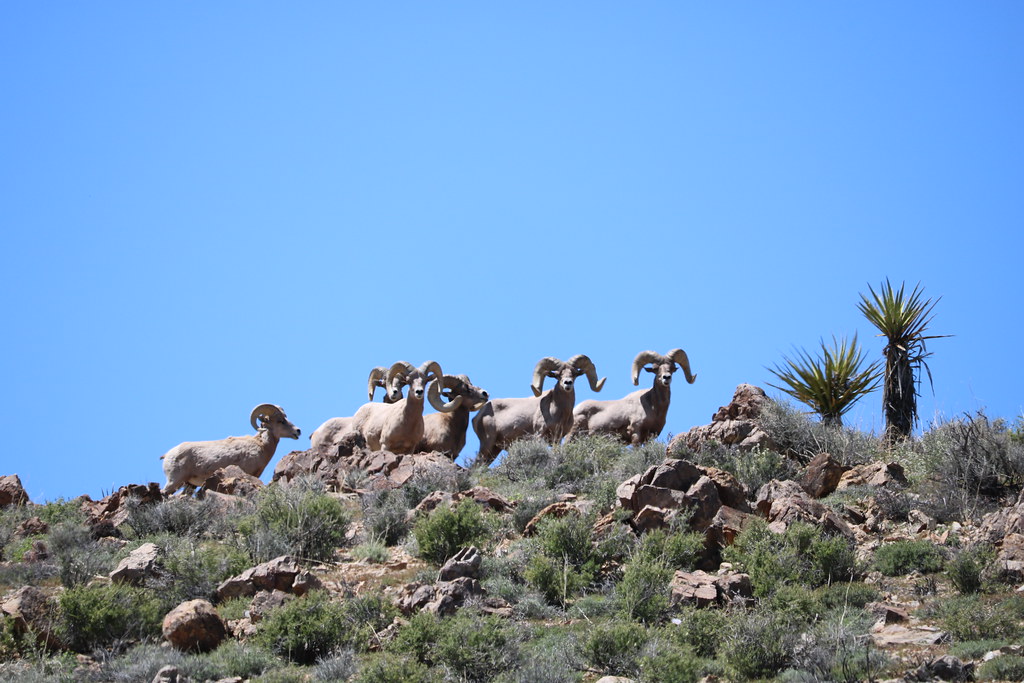
Bighorn Sheep in Joshua Tree
The desert bighorn is Joshua Tree's largest native mammal and one of its most awe-inspiring sights — a heavy-bodied, sure-footed animal navigating cliffs with effortless precision. Here's what you need to know about them.
The desert bighorn sheep has lived in Joshua Tree's boulder fields and rocky canyons for thousands of years. Long before the park existed, Native American rock art throughout the region depicted these animals — a testament to how central they were to the desert ecosystem and the cultures that depended on it.
Today, an estimated 100 to 200 bighorn live within the park's boundaries, divided into three loosely separate populations. They are the largest native mammal in the park, and among the most impressive: a full-grown ram can weigh over 200 pounds and carry a set of curling horns that weigh nearly 30 pounds on their own. The horns grow throughout the animal's life and are a direct signal of age and rank within the herd.
What makes bighorn sheep extraordinary is their physical adaptation to the terrain. They navigate cliff faces on hooves that are sharp-edged, elastic, and slightly concave — built like climbing shoes. They can move across level ground at 30 mph and scramble up steep slopes at 15 mph. A ledge two inches wide is enough for a foothold. They bounce between ledges spanning 20 feet as casually as you'd step over a puddle.
How Bighorn Sheep Live
Social Structure
For most of the year, rams and ewes live separately. Ewes form matrilineal family groups — mothers, daughters, and sisters — that remain together for life. Young rams eventually leave their birth herd and join bachelor bands, wandering between ewe groups during the August–September rut. Older rams, recognizable by their massive full-curl horns, compete for mating access through dramatic head-butting battles that can be heard echoing across canyon walls.
Diet & Water
Bighorn graze on a wide variety of desert plants — green grasses when available, cacti, and shrubs the rest of the year. They have a complex nine-stage digestive process that maximizes nutrient extraction from poor-quality desert forage. Water is critical and often scarce: bighorn must reach a spring or water-holding depression at least every three days, and nursing ewes need water almost daily. The trek to water is the most dangerous moment in a bighorn's life — mountain lions wait in the narrow canyons where springs occur.
Reproduction
Mating peaks in August and September, though rutting behavior can occur at any time of year. After a gestation of 150–180 days, ewes typically give birth between January and April — usually a single lamb, rarely twins. Lambs grow quickly, forming their own playful bands within weeks of birth, seeking out their mothers mainly to nurse. By six months, they are fully weaned. Only about one-third of lambs survive their first summer — a harsh introduction to desert life.
Daily Activity
Desert bighorn are diurnal — active during daylight, moving to traditional bedding sites at night. In summer, they rest during the hot midday hours, often on exposed cliff ledges above a water source where breezes keep temperatures tolerable and their exceptional eyesight (effective at nearly a mile) gives them warning of approaching predators. They are most active in the cooler hours of early morning and late afternoon, which is when your best viewing opportunities occur.
Where to Find Bighorn in the Park
Joshua Tree's 100–200 bighorn sheep are divided into three loosely separate populations, each centered on a different part of the park. Your location within the park determines which group you're most likely to encounter.
Wonderland of Rocks & Queen Mountain
The population most frequently spotted by visitors. The Wonderland's boulder labyrinth and surrounding slopes provide ideal bighorn habitat — steep, rocky, and adjacent to water at Barker Dam. Scan the high ridgelines above Barker Dam trail early in the morning and near sunset. These animals are accustomed to park visitors and sometimes come quite close.
Cottonwood & Eagle Mountains
A separate population centered on the Cottonwood Spring area and the Eagle Mountains in the park's far east. Cottonwood Spring itself is a critical water source — bighorn have been documented drinking here regularly in summer. Visit the spring at dawn for your best chance. The 49 Palms Oasis, in the park's north, is another reliable water-draw spot for this population.
Little San Bernardino Mountains & Keys View
A third population ranges through the higher terrain of the Little San Bernardino Mountains, including the area around Keys View. Sightings here are less frequent for casual visitors but do occur — scan the rocky slopes below the Keys View overlook and along the ridge to the south. These are the bighorn at the highest elevations in the park.
Hidden Valley & Skull Rock Area
Occasional sightings are reported from the rocky terrain around Hidden Valley and the Skull Rock area along Park Boulevard. These tend to be transient individuals or young rams moving between ranges rather than established populations — a sighting here is a bonus, not a guarantee. Worth scanning the surrounding boulders whenever you're in this central part of the park.

A Species Under Pressure
Disappearing Water Sources
This is the most immediate threat to Joshua Tree's bighorn sheep. Since 2006, the park has lost approximately 50 percent of the springs and seeps that bighorn rely on for summer water. As the climate warms and rainfall patterns shift, springs that have sustained desert wildlife for millennia are simply drying up. Bighorn that can't reach water every three days don't survive summer.
Disease from Domestic Livestock
Desert bighorn have little resistance to the respiratory diseases carried by domestic sheep and goats. Contact with livestock — even brief, indirect contact — can trigger pneumonia outbreaks that devastate entire herds. A 2015 event inside the park resulted in a bighorn testing positive for a contagious bacterial pneumonia. Today the population is only about 10 percent of what existed before European settlement of the West.
Human Disturbance
Joshua Tree has seen dramatic increases in visitation over the past decade. Research shows that bighorn sheep alter their movement patterns, abandon water sources, and experience elevated stress in response to human presence — even at distances that feel respectful to visitors. The park monitors bighorn movements with GPS collars to understand how increased visitation is affecting their behavior and habitat use.
Mountain Lion Predation
The mountain lion is the adult bighorn's only significant natural predator in Joshua Tree. Lions concentrate near the narrow canyons where springs occur, making the essential trip to water a life-or-death gauntlet for bighorn. Most dead bighorn found in the park are mountain lion kills. This predation pressure is a natural part of the ecosystem, but it interacts badly with the loss of water sources — fewer springs means bighorn must travel farther and through more dangerous terrain to survive.
How to Watch Without Disturbing
Go at dawn or dusk
Bighorn are most active in the cooler hours at either end of the day. Midday visits in spring and summer — when the animals are resting on shaded ledges — produce fewer sightings. Arriving at Barker Dam or Cottonwood Spring at first light gives you the best chance of seeing them actively moving and foraging.
Bring binoculars
Bighorn sheep are most often spotted at distance on rocky ridgelines and cliff faces. A pair of 8x or 10x binoculars dramatically increases what you'll see — and lets you observe them without getting close enough to cause a disturbance. Scan slowly across the high terrain rather than looking at the trail immediately in front of you.
Stay at least 100 yards away
NPS regulations require staying at least 100 yards from bighorn sheep. Even at that distance, research shows that human presence affects their behavior. If a bighorn changes its movement, looks up and stares at you, or moves away — you are too close. Back up slowly and give it space. Never approach a bighorn to get a better photo; use your zoom lens from a respectful distance.
Don't linger near water sources
Springs, seeps, and oases are critical survival infrastructure for bighorn — especially in summer. If you're visiting Cottonwood Spring, 49 Palms Oasis, or Barker Dam, be aware that bighorn may be waiting for a clear path to water. Keep your visit short, stay quiet, and move on. A bighorn that's been scared away from its only nearby water source faces a real survival consequence.
Report your sightings to the NPS
The park actively tracks bighorn sheep movements and population health. If you see bighorn — especially collared individuals, animals that appear injured or sick, or unusual group sizes — report it to a ranger or use the NPS wildlife sighting form online. Your observation contributes directly to the park's conservation monitoring program.
Experience Joshua Tree with a Local Guide
Summit Climbing Guides leads small-group trips and private guided experiences throughout Joshua Tree National Park. We know the terrain, the wildlife, and the best spots for a real desert encounter.